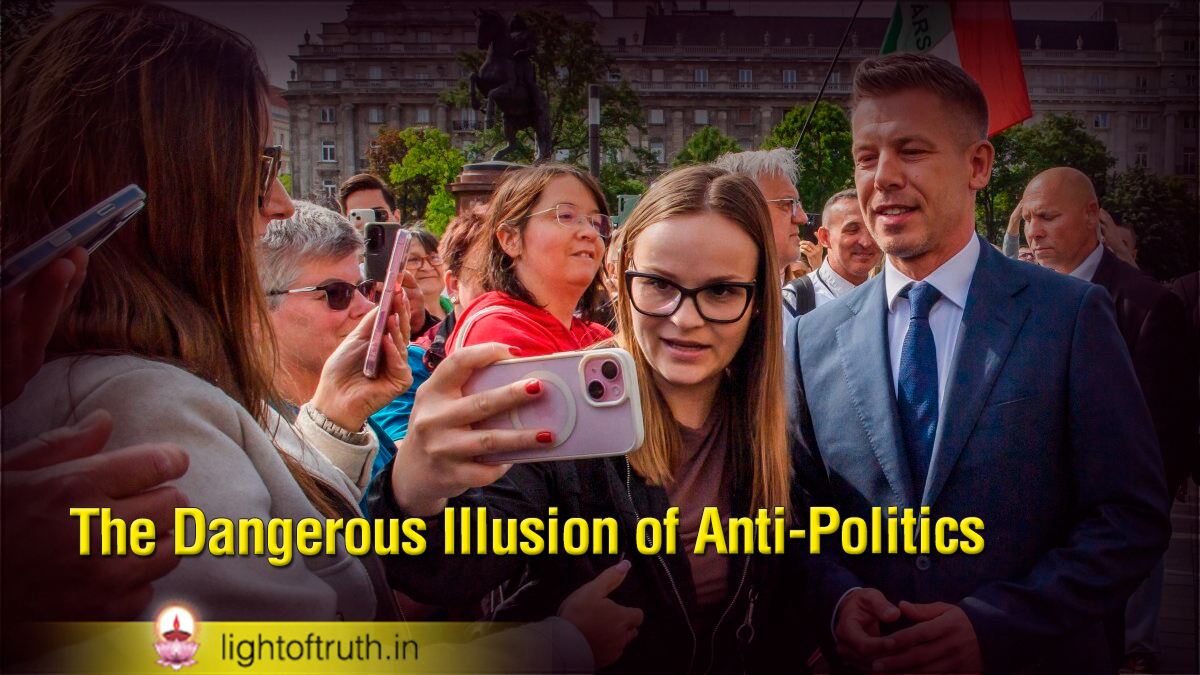
Countless analyses have already been written about the causes of Péter Magyar and the Tisza Party’s landslide success and the resulting electoral realignment. Yet, there is a crucial factor that receives relatively little attention: the complete depoliticization of political struggle. The parliamentary elections birthed the newest and most successful product of the 21st-century Hungarian wasteland: anti-politics has become the new politics, a trend that Tisza is now driving to its absolute peak in government.
It is worth observing Péter Magyar’s and his party’s communication. The cornerstone of their rhetoric is that they themselves are not part of the political class in the classical sense. A recurring trope during the election campaign was that the people behind Tisza are not career politicians, but civilians and patriotic professionals. He also stated, “This homeland does not need street fighters or rusted terminators but decent, honest people working so that every Hungarian can feel Hungary is their own.” Or consider another statement: “I didn’t embark on this to topple the entire power elite; I am merely a spark that can start the engine”-all these points in a single direction.
Through a calculated marketing strategy, they have distanced themselves-and continue to distance themselves-from ‘politics’ and the word ‘politician.’
The communication framework employed by Tisza’s politicians appears to be an effective strategy during the post-election honeymoon phase. Yet, simultaneously, they are engaging in a highly classical power game. In his seminal work The Concept of the Political, Carl Schmitt warned that the sharpest and most ruthless political weapon is attempting to depoliticize political struggle while cloaking one’s own position in a veil of morality. According to Schmitt, anyone who claims not to engage in politics but merely represents “the good” or “the pure people” against a “corrupted elite” does not treat their opponent as a rival but brands them a moral monster.
However, this calculated distance creates a trap. As painful as the realization might be for the newly minted representatives and Tisza voters alike, the moment they ran in the elections, secured mandates, and assumed positions of public authority, they, too, became politicians.
This Schmittian strategy can be sold so masterfully in Hungary today because the word ‘politics’ has become irredeemably pejorative-degraded and sullied.
Who will replace the politician?This is exactly where the greatest danger lies. In his classic work In Defence of Politics, British political scientist Bernard Crick warned, among other things, that politics is not a necessary evil, but rather civilization’s greatest achievement—the art of resolving conflicts without violence. Anti-politics ostensibly promises voters an epistocracy (the rule of the knowledgeable, the intelligent, and independent experts) whereby ‘the thoroughly corrupt state apparatus will magically be fixed.’ In reality, if we eliminate politicians, their place can be taken by only two types of people.
For years, domestic research on institutional trust-particularly studies focusing on the post-communist region-has highlighted that confidence in political institutions in these societies, especially in parties and parliament, is drastically low. This is unequivocally a bad sign; when institutional trust erodes to such an extent, a demand inevitably arises for an ‘outsider’ (in politics, not in a partisan sense)-a savior arriving from beyond the existing establishment. When voters feel that the playing field itself is flawed, they no longer simply demand a change in the rules; they want to flip the entire table.
The first is the technocrat, who governs by appealing to their expertise. However, as Max Weber pointed out, these individuals are mere executors who lack both political passion and the sense of responsibility required for a political vision. The second—and more realistic—danger is kakistocracy, or the rule of the incompetent. When political routine, a willingness to compromise, and a knowledge of state administration are stigmatized, amateurism suddenly transforms into a virtue. By repackaging outsider status as freshness and inexperience as innocence, we pave the way for chaos. It is therefore a dangerous illusion to believe that politics can be eradicated or substituted with experts and civilians. Politicians remain a necessity, especially during uncertain times riddled with crises. At present, the duty of citizens is not to abolish politics for good but to continue demanding its responsible and professional practice. The death of politics never brings purification; rather, it spells the end of discourse and the birth of autocracy—or chaos.