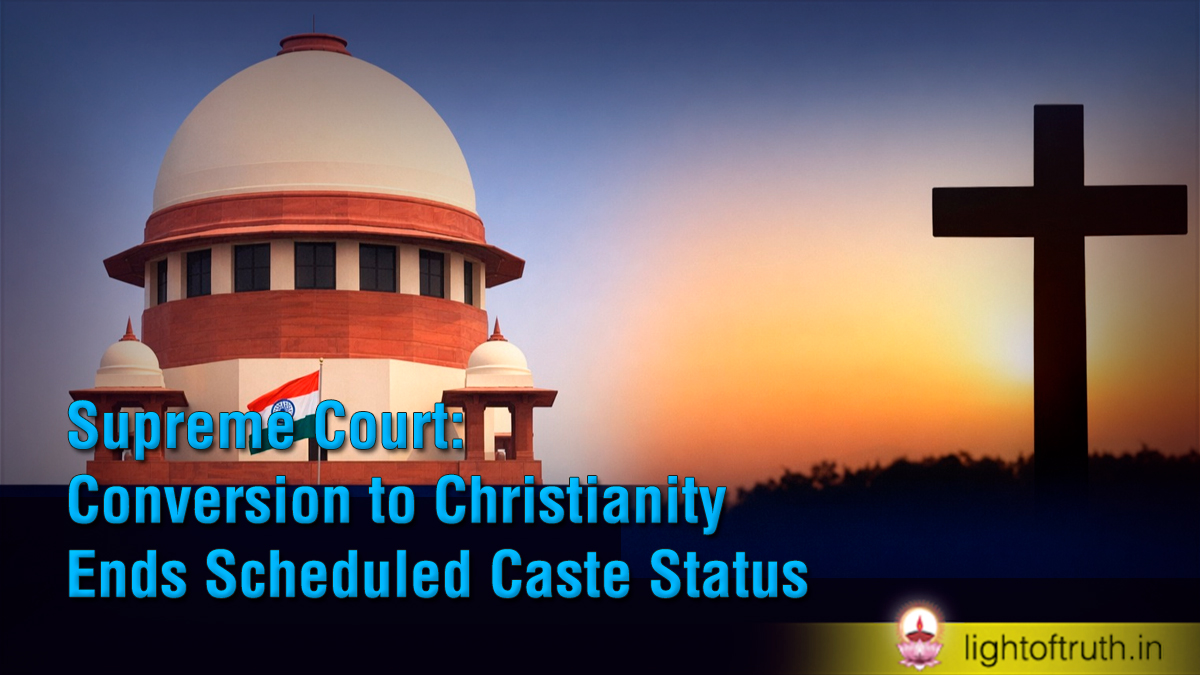
The Supreme Court of India on March 24 upheld a ruling that a person who converts to Christianity cannot be considered a member of a Scheduled Caste. The court affirmed an earlier decision of the Andhra Pradesh High Court on the issue.
The judgment referred to the Constitution (Scheduled Castes) Order, 1950, which states that Scheduled Caste status is limited to those who follow Hinduism, Sikhism, or Buddhism. The court said this rule is absolute and that conversion to any other religion results in the immediate loss of Scheduled Caste status.
The bench, including Justice Prashant Kumar Mishra and Justice Manmohan, clarified that a person cannot practice another religion and still claim benefits meant for Scheduled Castes. This includes protections, reservations, and legal rights under various laws.
The case involved a man who had converted to Christianity and was working as a pastor. He had filed a complaint under the SC/ST (Prevention of Atrocities) Act, alleging assault and threats. The accused challenged the complaint, saying it was not valid since the man was no longer part of a Scheduled Caste.
Earlier, the High Court had ruled that caste does not apply within Christianity and dismissed the case. The Supreme Court agreed, noting that the man continued to practice Christianity and had not returned to his original religion.
The court also said that having a caste certificate does not automatically give legal protection if a person has changed religion, as such matters must follow legal rules.