QUESTION : Can we justify the present war in Iran and what would be the message of the Risen Jesus at this moment? – Joseph Chacko
ANSWER : Saji Mathew Kanayankal CST
After four years of Russian invasion of Ukraine, we now witness another brutal and devastating conflict, often described as a “space war,” that threatens to reshape the global order and the very fabric of human ethos. Through these wars, along with numerous other conflicts across the world, the human condition is deeply disfigured, and humanity continues to endure bloodshed, tears, sorrow, suffering, and profound agony. Yet, amid such darkness, we still dare to hope for peace and continue to pray for its realisation.
Over the years, numerous diplomatic efforts, mediations, and negotiations have sought to resolve the hostility between Iran and the US and its alley Israel. However, on the morning of 28 February 2026, the US and Israeli forces reportedly launched a large-scale attack across Iran, targeting military installations, missile infrastructure, and leadership centres in Tehran and other parts of the country that killed Ayatollah Ali Khamenei, the Supreme Leader of Iran since 1989 along with several senior members in the Iranian leadership. Describing these strikes as “unprovoked, illegal, and illegitimate,” Iran retaliated by launching waves of ballistic missiles and drones aimed at Israeli population centres and at Arab Gulf states hosting US forces. The conflict has since escalated dramatically, drawing in multiple regions, with attacks affecting not only the Middle East but also extending toward parts of Europe and the situation continues to unfold even today.
Justifications, But not Reasonable!
Since the Islamic Revolution in 1979, Israel and its closest ally, the US, have viewed Iran as a principal adversary. In turn, the Iranian leadership have repeatedly expressed hostility toward Israel, at times calling for its elimination. Israel, for its part, perceives Iran as an existential threat and has called for the complete dismantling of its nuclear and missile capabilities. Iran’s continued development of ballistic missiles and advancements in nuclear technology have further intensified these tensions. Though a brief conflict erupted in June last year, it has not lasted long. Despite ongoing doubts and deep mutual scepticism, several rounds of mediation and negotiation have taken place in an effort to ease tensions. However, these efforts have faced significant challenges with the comment of the US President Donald Trump that he was not happy with Iran’s position.
Israel and the US have justified their attack on Iran as a “pre-emptive strike” intended to neutralise perceived threats. However, they have not provided a sufficiently convincing explanation regarding the necessity of undertaking military action at this particular moment. Trump has argued that Iranian missiles could eventually reach the US. Yet, this claim appears to have been made without credible evidence and, in some instances, in contradiction to assessments reportedly issued by his own administration’s intelligence and defence agencies. Although several lawmakers in the US have called upon the administration to present clear evidence that Iran posed an imminent threat prior to the escalation, neither the president nor his supporters have offered a fully satisfactory justification.

“I got him before he could get me.” This claim may be understood as a fleeting mental construct rather than a carefully grounded moral justification. He presents the war as a form of preventive retaliation, even framing it as a necessary act of pre-emption. In doing so, the leader of the so-called free world appears to justify violence as a means of securing dominance.

Despite repeated efforts by President Trump to persuade the American public of the necessity of war, such arguments have not achieved widespread acceptance. Nonetheless, according to White House Press Secretary Karoline Leavitt, the president maintained that he “had a good feeling Iran was going to strike.” As commentator Shannon Gormley observes, “Trump offered no logic, however twisted; no evidence, however drummed up; no argument in any recognisable form. Just words, from his head.”
Trump also claims that the elimination of Khamenei is way to give freedom for the people of Iran. Though there are many evidences of the protests of Iranian in the street for a free state, can we accept the method Trump and Netanyahu have used to eliminate a leader of a sovereign country? Attacking a sovereign nation is not justifiable and killing thousands of innocents including children and women to eliminate an enemy is a crime. Moreover, neither did Trump unveil a plan to free the Iranian people from the regime that has tormented them, a plan that any reasonable person would have surely formed before taking an action. There is no clarity that Trump had such plan, or he had a clear objective.
Trump also advances an argument of self-defence, stating, “I got him before he could get me.” This claim may be understood as a fleeting mental construct rather than a carefully grounded moral justification. He presents the war as a form of preventive retaliation, even framing it as a necessary act of pre-emption. In doing so, the leader of the so-called free world appears to justify violence as a means of securing dominance. Some columnists have compared this line of reasoning to the logic of fascist warfare, as seen in the regimes of Mussolini and Hitler. In those historical instances, invasions were also accompanied by justifications; “dishonest reasons, imperialist reasons, evil reasons, but reasons nonetheless.” By contrast, in the present attack on Iran, neither Trump nor his Israeli counterpart, Benjamin Netanyahu, appears to have meaningfully consulted their respective legislative bodies, such as the US Congress or the Israeli Parliament. Even the European Union, a long-standing ally of both the US and Israel, seems to have been taken by surprise.
According to this critique, the attack on Iran was not primarily motivated by concerns over nuclear weapons, the defence of Israel, or the prevention of an imminent threat. Rather, as Gormley argues, “the reason Trump attacked is this: because he could, because he felt like it, because war is violent and chaotic and cruel and a visually spectacular distraction—and he enjoys all of these things.”
Peace: Impossible through Violence
The opposition to the war is very evident from the comments of many world leaders, especially the leaders from Europe. Their response in general has been marked by shock, scepticism, and above all, a retreat into debates about principles. They have made comments on regional stability, energy security, and the moral credibility of democracy. While Italy and France has taken more legally critical stance, Spain’s Prime Minister Pedro Sánchez strongly condemned the attacks and refused to allow the US forces to use Spanish bases for military operations against Iran.
Among global leaders, strong criticism of the war came from Pope Leo XIV. Though his statements remained indirect and apolitical to avoid escalating tensions, other Church leaders were more explicit. Cardinal Robert McElroy, the Archbishop of Washington, called the war morally unjustifiable, Cardinal Blase Joseph Cupich, the Chicago Archbishop, described it as “sickening,” and Cardinal Pietro Parolin, the Vatican Secretary of State, rejected claims of a “preventive war.” On 1 March, at the outbreak of the conflict, Pope Leo warned of “a tragedy of enormous proportions” and urged all parties to halt the spiral of violence before it becomes irreparable. On 15 March, he lamented the suffering caused by the “atrocious violence of war,” stressed that violence cannot bring justice or peace, called for a ceasefire and renewed dialogue, and condemned invoking God to justify war.
According to Pope Leo XIV, dialogue is the only path to peace; when sought through violence, peace cannot endure. In his 1 March message, he stressed that stability and peace are built not by threats or weapons, but through “reasonable, authentic and responsible” dialogue, and prayed that diplomacy would once again serve the common good. In his New Year address on 9 January 2026 to ambassadors, he warned that war is “back in vogue,” that the post–World War II principle against violating borders by force has been undermined, and that peace is now pursued through weapons rather than as a good in itself; endangering the rule of law. He called for a return to sincere diplomacy, but his appeal went unheeded.
Peace in a World of Violence!
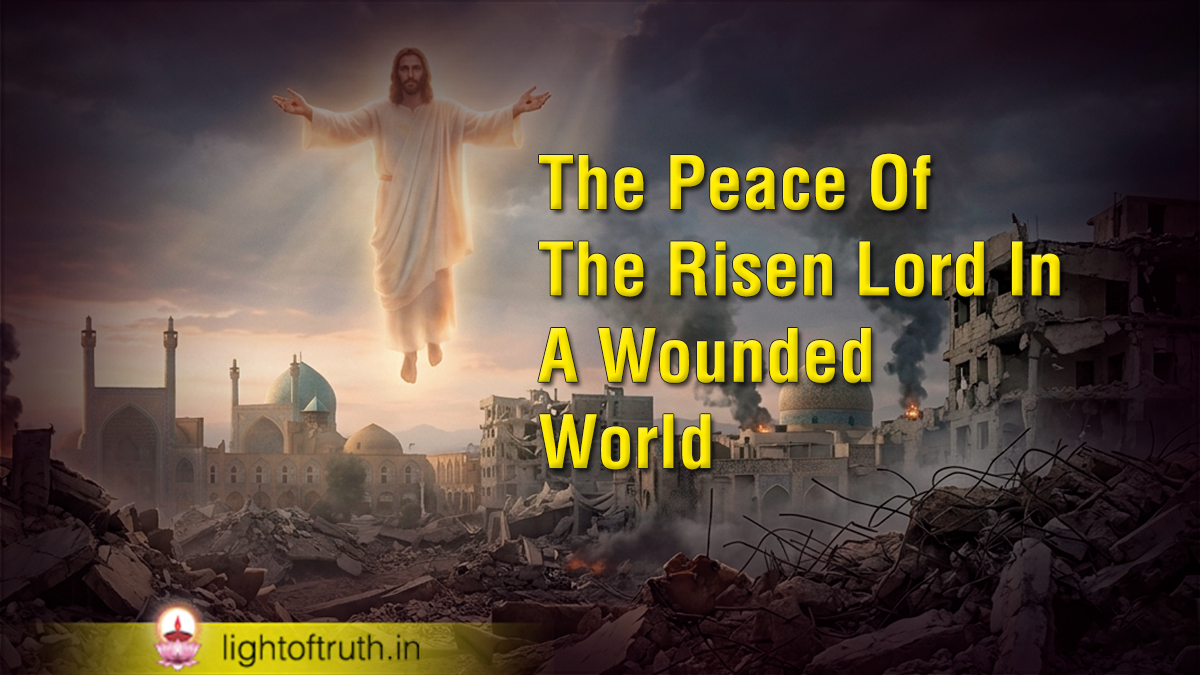
In the present world wounded by the scars of war and violence the word of peace of the Risen Lord consoles us and offers new hope and promise. The Resurrection of Jesus tells that life triumphs over death and love overcomes violence. The Resurrection does not ignore the reality of violence; rather, it confronts with a transformative vision of peace, reconciliation, and hope.
The narrations in the Gospel after the crucifixion of Jesus gives a picture of disciples, gathered in fear, anxiety and despair. The brutal execution of their master by political and religious authorities had shattered their hopes and dreams. The opponents of Jesus were powerful both politically and economically. The disciples had no idea to overcome the brutal ‘reign of the might.’ Their future and destiny were in darkness. It is precisely into this atmosphere of fear and uncertainty that the Risen Christ appears with the words: “Peace be with you” (Jn 20:19).
The Resurrection also reveals that violence does not have the final word in history. The crucifixion represents the extreme manifestation of injustice, hatred, and political brutality. Yet God’s act of raising Jesus from the dead demonstrates that the forces of oppression and death cannot ultimately prevail.
Pope John Paul II, in many of his Easter reflections, speaks of hope arising in the midst of sorrow and darkness. He connects the biblical experience of “night” with the mystery of salvation. In Scripture, the Spirit of the Lord is active precisely when darkness seems to prevail over the earth. The various “nights” in the Bible (the night before creation, the night of the Exodus, and the night following the death of Jesus) are moments when the power of darkness and sorrow appears overwhelming. Yet, in each of these moments, the Spirit of the Lord is at work, preparing a new beginning, even though those who suffer are not fully aware of it. As he beautifully expresses it: “While all is shrouded in darkness, God—the Light—keeps watch. With him keep watch all who hope and trust in him.” This quiet hope in the midst of darkness and emptiness captures the profound expectation at the heart of Easter.
The greeting of Jesus after resurrection is not merely a conventional salutation but a profound theological proclamation. The peace offered by the Risen Lord is the peace of reconciliation and restored communion, a peace that stands in stark contrast to the violence that had led to his death. In the context of war, this message reminds us that peace is not simply the absence of conflict but the restoration of justice, dignity, and right relationships.
The Resurrection also reveals that violence does not have the final word in history. The crucifixion represents the extreme manifestation of injustice, hatred, and political brutality. Yet God’s act of raising Jesus from the dead demonstrates that the forces of oppression and death cannot ultimately prevail. The Resurrection therefore becomes a divine affirmation that God stands with the victims of violence and that the apparent triumph of injustice is only temporary. For communities torn apart by war, this proclamation offers a powerful hope; history is not governed solely by human aggression but is ultimately directed toward God’s justice and life.
Ultimately, the Resurrection reveals that God’s final word is not destruction but life. In the midst of war and human conflict, the Risen Christ invites us to embrace a new horizon of hope. His message calls believers to reject hatred, resist the logic of violence, and commit themselves to building a culture of peace. The Resurrection thus stands as a perpetual reminder that even in the darkest moments of history, the light of God’s life-giving love continues to shine.