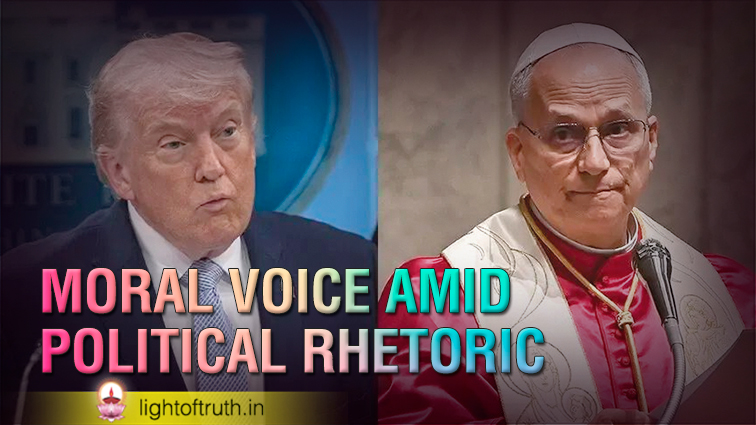
- QUESTION : How should the dispute between Pope Leo XIV and Donald J. Trump be evaluated as religious intervention in politics?
– Saji
ANSWER:
Saji Mathew Kanayankal CST
The recent conflict between Pope Leo XIV and the U.S. President Donald J. Trump highlights a striking tension between the moral authority of the Catholic Church and the political leadership of the United States. Trump’s public condemnation of the Pope, following Leo’s criticism of U.S. military action in Iran, has intensified strains between the Vatican and Washington. On his social media platform, Trump accused the Pope of being “weak on crime and terrible for foreign policy,” and in a lengthy post on 12 April 2026, he urged Leo to “focus on being a great Pope, not a politician.”
The controversy has deepened as both leaders continue to defend their positions. The Pope has reiterated his commitment to peace, while Trump has refused to apologise for his remarks. He has argued that the Pope’s statements against war harm the Catholic Church and claimed that he has “done more for the Catholic Church than any president in the last hundred years.” He further pointed to financial support provided during the COVID-19 pandemic, insisting that such contributions have not been adequately acknowledged.
The dispute intensified when Trump posted, then deleted, an AI-generated image depicting himself in a Christ-like role, drawing criticism from both religious and political leaders. For his part, the Pope, while stating that he has no desire to escalate the conflict, has made clear that he will not be intimidated and will continue to speak out against war. Although the immediate disagreement centres on the question of war, it also reveals deeper divisions regarding political power, immigration, and the role of religion in public life.
Pope Leo: An Apostle of Peace
The opposition of Pope Leo XIV to the present war is not rooted in political calculation but in moral and theological conviction. Since the election to the Supreme Pontificate, his interventions in situations of conflict have followed a consistent pattern. In 2025, as violence intensified in Ukraine, Gaza, and Sudan, he repeatedly called for ceasefires, the protection of civilians, and renewed diplomatic engagement. Rather than adopting strategic or geopolitical language, he has consistently centred his appeals on human dignity and the moral cost of war. On 8 March 2026, as tensions surrounding Iran escalated, he called for an immediate end to bombing and urged that “weapons may fall silent” to make space for dialogue. A few weeks later, on 11 April, during a prayer vigil at St. Peter’s Basilica, he intensified his appeal, warning against what he described as a “delusion of omnipotence” that fuels war, and issued a stark plea: “Enough of war!”
This position must be understood within the broader framework of Catholic moral theology, especially the Gospel vision of peace, the tradition of Just War Theory, and the modern social teaching of the Church. At the heart of Christian teaching lies the message of peace proclaimed by Jesus Christ. In the Beatitudes, he declares; “Blessed are the peacemakers, for they shall be called children of God” (Mt 5:9). As Christian reflection developed, the just war tradition articulated that war could be morally permissible only under strict conditions like just cause, legitimate authority, right intention, last resort, proportionality, and the protection of civilians. These criteria were never intended to legitimise war easily but to impose rigorous moral limits on the use of violence.

Absurd and inhuman violence is spreading ferociously through the sacred places of the Christian East. Profaned by the blasphemy of war and the brutality of business, with no regard for people’s lives, which are considered at most collateral damage of self-interest.

Within this theological horizon, peace is not merely a political objective but an essential dimension of Christian discipleship. For the Church, peace is more than the absence of war; it is the fruit of justice, solidarity, and respect for human dignity. It is precisely from this moral vision that Pope Leo speaks. He insists that the Church has a duty to raise its voice whenever human life is threatened by war, and he has therefore refused to remain silent despite criticism from political leaders.
His message remains consistent and uncompromising; power must be subject to moral judgment, violence must be restrained, and invoking God to justify destruction distorts both religion and public life. Repeatedly, he has called for dialogue, restraint, and diplomatic engagement, describing threats of escalation as “truly unacceptable” and raising serious concerns under both moral reasoning and international law. He has also encouraged citizens to hold their leaders accountable and to advocate actively for peace.
Critique on the Manipulation of Religion
Alongside his persistent plea for peace, Pope Leo XIV has sharply criticised the misuse of religion to justify war. On 10 April 2026, in a social media post that avoided naming specific individuals, he condemned the use of Christian nationalist rhetoric to legitimise the U.S. and Israel’s military actions against Iran. Writing on his official X account, he stated: “God does not bless any conflict. Anyone who is a disciple of Christ, the Prince of Peace, is never on the side of those who once wielded the sword and today drop bombs.” He further emphasised that “military action will not create space for freedom or times of peace, which come only from the patient promotion of coexistence and dialogue among peoples.”
In contrast, Donald Trump and other senior U.S. officials, particularly Pete Hegseth, the defence secretary, have employed explicitly religious language in framing the conflict. Trump suggested in media interactions that he believes God supports U.S. actions in Iran. Hegseth, for his part, described the conflict in overtly religious terms, portraying it as a form of holy struggle “in the name of Jesus Christ.” He also drew a controversial parallel between the rescue of a pilot from a downed F-15E fighter jet during the Easter weekend and the resurrection of Jesus Christ. Recounting the incident, he remarked; “Shot down on a Friday, Good Friday, hidden in a cave, a crevice, all of Saturday and rescued on Sunday, flown out of Iran as the sun was rising on Easter Sunday, a pilot reborn. All home and accounted for. A nation rejoicing. God is good.”
Responding to such rhetoric on the same day, Pope Leo issued a strong rebuttal; “Absurd and inhuman violence is spreading ferociously through the sacred places of the Christian East. Profaned by the blasphemy of war and the brutality of business, with no regard for people’s lives, which are considered at most collateral damage of self-interest.” His words highlight a profound theological concern that invoking God to justify violence constitutes a distortion of both faith and moral responsibility.
This position is not new within the Church’s tradition. During the 2022 Russian invasion of Ukraine, Pope Francis similarly warned against the instrumentalisation of religion for military purposes, insisting that “the sacred must not be instrumentalised by the profane.” The consistent teaching of the Church affirms that religion must never become a tool in the hands of political power. For Pope Leo, the moral clarity on war remains uncompromising; “No gain can be worth the life of the weakest, children, or families. No cause can justify the shedding of innocent blood.”
Moral Voice in an Era of Post-Truth Politricks
Political leaders often act and speak within the limits of their socio-cultural contexts, prioritising national interests, security concerns, and strategic advantage. The Vatican, however, operates from a different horizon, one shaped by ethical and theological principles. In a well-ordered system of governance, these perspectives need not be in conflict; ideally, they should converge in the service of the common good. Yet when political leadership, such as that of Donald Trump, appears driven by personal assertion, unilateral agendas, or a disregard for international norms, the moral responsibility of the Church to speak for peace and justice becomes more urgent.
The interventions of Pope Leo XIV are not aligned with or opposed to any political party or ideology. Rather, they arise from a consistent moral framework. When political leaders fail to respond to ethical concerns, the post-truth political rhetoric dismisses such interventions as ‘political.’ Leo himself has clarified that he does not seek to interfere in political processes as a religious authority. Instead, he understands his role as proclaiming the Gospel message of peace with clarity and courage. This was evident during his visit to Algiers, where he stated; “We are not politicians, we don’t deal with foreign policy with the same perspective he might understand it, but I do believe in the message of the Gospel, as a peacemaker.”
This same approach is evident across a range of issues beyond war. On migration, he frames the debate in terms of human dignity, questioning whether harsh policies toward migrants can be reconciled with a consistent ethic of life. On social questions, he resists partisan categorisation, insisting that moral coherence must take precedence over political alignment. His engagement with artificial intelligence follows a similar pattern; in December 2025, he warned that technological development must serve the common good rather than concentrate power in the hands of a few. Across these areas, his method remains consistent: he begins with principles, not interests; he avoids factional alignment; and he applies moral reasoning even at the cost of political backlash.
A closer analysis shows that this is not an entirely new position but a continuation of long-standing Catholic teaching. What distinguishes Leo XIV is the clarity and directness with which he articulates it. He draws a firm distinction between two forms of authority; one grounded in political power, the other in moral responsibility. He does not claim the authority to determine political outcomes, but he insists on the right and the duty to evaluate them ethically.
Addressing participants at the plenary session of the Pontifical Academy of Social Sciences (14–16 April 2026), he argued that the legitimacy of authority depends not on the accumulation of economic or technological power but on the wisdom and virtue with which it is exercised for the common good. Wisdom, he noted, is inseparable from moral virtue and enables individuals and societies to discern “the true and the good” rather than be misled by superficial gains or vainglory.
Reflecting on the current political climate, he warned that democracy remains healthy only when it is rooted in moral law and a genuine vision of the human person. He also cautioned against the dangers of “majoritarian tyranny,” which can become a mask for the dominance of economic and technological elites. In particular, he highlighted that the concentration of technological, economic, and military power in the hands of a few threatens both democratic participation and international harmony.
Conclusion
Despite sustained criticism from supporters of Donald Trump, the firm and consistent stance of Pope Leo XIV against war carries significant credence in today’s world which is marked by nuclear weapons, technological warfare, and deep geopolitical tensions. The Christian call to peace making is not an abstract ideal but a concrete responsibility in a world fractured by violence and division. It challenges humanity to move beyond the very logic of war. In an age threatened by unprecedented destructive power, the Church continues to affirm that authentic peace can only be built through justice, dialogue, and solidarity among peoples. Within this vision, Christians bear a moral obligation to act as agents of reconciliation, making peace building a central dimension of discipleship.
The widespread assumption that peace and security can be secured through military strength is directly challenged by the Pope’s appeal for dialogue and reconciliation. For him, peace is not merely a political goal but a theological reality rooted in Christ himself. The New Testament proclaims Jesus Christ as “our peace” (Eph 2:14), the one who reconciles humanity with God and with one another. Thus, the Church’s commitment to peace flows from the mystery of Christ’s reconciling love. By rejecting the logic of violence and embracing reconciliation, Pope Leo XIV calls both Christians and the wider world to share in God’s ongoing work of restoring harmony in a divisive world.