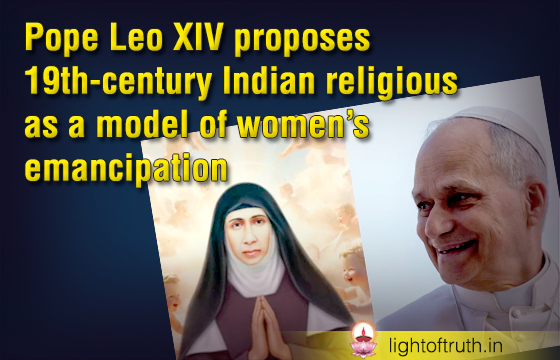
Pope Leo XIV spoke of the beatification this week of Mother Eliswa Vakayil, a 19th-century Indian religious and founder of the Third Order of the Teresian Discalced Carmelites, highlighting her “courageous commitment to the emancipation of the poorest girls.” “The witness of Mother Eliswa Vakayil,” the pope affirmed during his greetings in Italian at the end of his general audience on Nov. 12, “is a source of inspiration for all who work in the Church and in society for the dignity of women.”
The beatification ceremony on Nov. 8 was held in the square in front of the Basilica-Shrine of Our Lady of Ransom in Vallarpadam, Kochi, in the Indian state of Kerala, and was presided over by Cardinal Sebastian Francis, Archbishop of Penang, Malaysia.
Before thousands of faithful and men and women religious from across the country, the cardinal emphasized that the new blessed represents “a beacon of hope” for all “consecrated women, for all mothers, and for all those who suffer in silence and yet choose to love,” according to Vatican News.
During the homily at the beatification, the cardinal emphasized the “inclusive vision” of Mother Eliswa Vakayil, with which she “was ahead of her time and is a true expression of synodality in action: walking together in communion.” The new blessed, he added, “shows the way” to the Church on its synodal journey “listening, discerning, and walking together.”
The foundation of her “unwavering faith,” he affirmed, “lies in her spirituality, vision, and mission, all rooted in her identity as a faithful disciple of Jesus Christ through baptism, the very heart of synodality.” With the official recognition of her holiness, the Church proposes Mother Eliswa Vakayil as a model of evangelical life embodied in service to the poor, in the promotion of women, and in the building of fraternal communities.