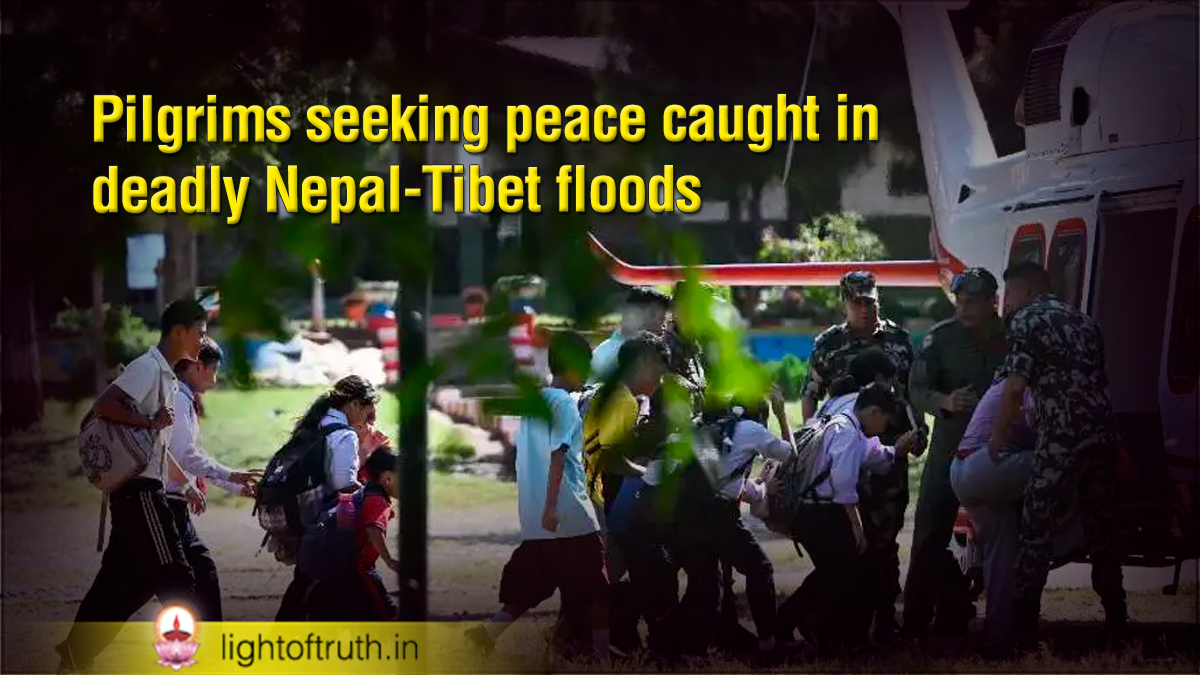
Mount Kailash is sacred to Hindus, Buddhists and Jains. They came to the Himalayas seeking spiritual renewal, drawn by Tibet’s sacred, snow-capped Mount Kailash. Instead, many pilgrims were caught in deadly floods that tore through the Nepal-Tibet region, wiping out entire villages. “I saw two buses carrying Indian pilgrims to Kailash Mansarovar,” said 27-year-old Laloma, a Nepali mother. She was rescued on Aug. 27 from Nepal’s devastated area of Syabrubesi, along with her infant son and husband, after sheltering for a freezing night in a school. The buses were swept away, she said.
“They are all gone,” she told AFP. Mount Kailash is sacred to Hindus, Buddhists and Jains. Hindus regard Kailash as the abode of deities Shiva and Parvati, while Tibetan Buddhists associate it with Mount Meru, which they say is the centre of the universe. It is forbidden to climb the 6,638-metre-high (21,778-foot) mountain. Instead, pilgrims undertake a roughly 52-kilometre (32-mile) contemplative circuit around its base, taking most walkers about three days.
For those en route or returning from the isolated, pyramid-shaped peak and bathing in the frigid ice waters of nearby Lake Mansarovar, across China’s frontier with Nepal, it was meant to be a healing journey of peace. But climate change is causing glaciers to melt worldwide, increasing the risks of glacial lake floods and glacial collapses.
On Aug. 26 morning, a tsunami-like wall of water and mud powered down, caused by a glacial collapse that sent a torrent of debris downstream, burying homes and sweeping away bridges. More than 470 people are dead and upwards of 1,400 others are missing in both China and Nepal.