The threat of violent extremism remains in the predominantly Catholic Philippines even after the end of a five-month siege by terrorists in a southern city, said Catholic and Muslim officials.
Fr. Jerome Secillano, executive secretary of the Philippines bishops’ Public Affairs Committee, told Catholic News Service that, according to some analysts and the president, “terrorist cells are already everywhere. It’s not only concentrated in Marawi, but there is a presence also in other parts of Mindanao.”
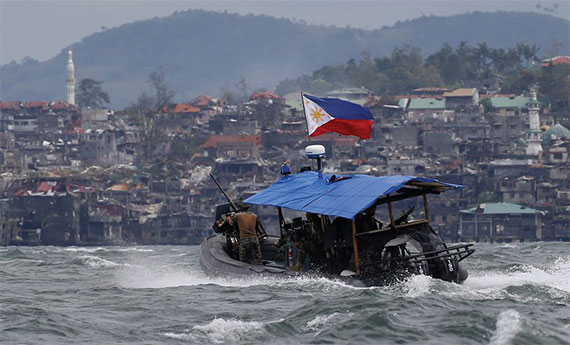
The historically peaceful Marawi on Mindanao Island in the South was the site of a sustained siege by Islamic State loyalists, who wanted to claim it as an IS caliphate. More than 1,100 people — mostly IS fighters — died in the battle where the fighters, fortified with munitions and provisions, withstood a military offensive backed by intelligence and special training from the United States, Australia and other countries.
The military killed two local leaders who headed the fight, prompting the president to declare the siege over.
Days later, Mindanao’s Cardinal Orlando Quevedo of Cotabato told reporters “the threat of terrorism is still there” and that extremist ideology and plans for a caliphate continue.
Manila-based terrorism analyst Rommel Banlaoi told CNS the fall of the IS-held capital of Raqqa, Syria, Oct. 17 meant the terror group would end moves to set up a worldwide caliphate in Iraq and Syria and decentralize. We value your input. Please help us improve NCRonline.org by taking this quick survey.
Banlaoi, executive director of the Philippine Institute for Peace Violence and Terrorism Research, said the caliphate would instead be in the “hearts and minds” of its fighters. He predicted IS would become more of a “franchise operation,” using the internet to urge followers to carry out terrorism acts against “the infidels and crusaders” in their home countries.
“ISIS is planning to set up a strong foothold in Asia,” he said. “And in Asia, the epicenter of their plan is the southern Philippines.”