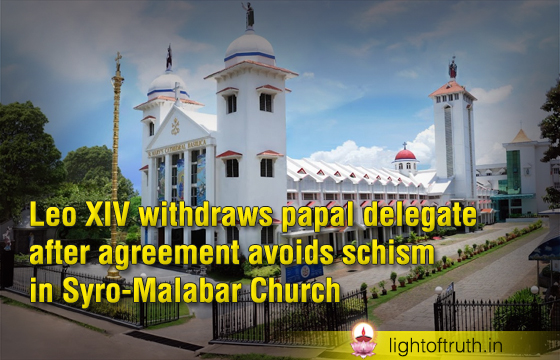
The specter of schism has hovered in recent years over the Metropolitan Archeparchy of Ernakulam-Angamaly of the Syro-Malabar Church in India—one of the 24 Eastern Churches in full communion with the Catholic Church. Parts of the clergy and faithful of Ernakulam-Angamaly, the largest Indian episcopal see in terms of the number of priests as well as the see presided over by the bishop in charge of the entire Syro-Malabar Church, did not accept the 1999 reform of the liturgical rite, which was later confirmed at the 2021 Synod of the Syro-Malabar Church.
Pope Leo XIV appears to have resolved the controversy by terminating the 2023 appointment of Archbishop Cyril Vasil’ as papal delegate to the Syro-Malabar Church to mediate the dispute. According to Vatican News, the official Vatican website, this decision by the pope “concludes the Holy See’s mediation work among the Syro-Malabars.”
Martin Bräuer, an expert at the Ecumenical Research Institute in Bensheim, Germany, told ACI Prensa, CNA’s Spanish-language news partner, that “Rome now considers the conflict over and therefore no longer needs a papal representative. Secondly, the agreement reached within the [Syro-Malabar] Church without the direct mediation of Archbishop Vasil’ is recognized.”
Indeed, the news comes after new measures to implement the liturgical reform approved by the 2021 Synod came into effect on July 3, the feast of St. Thomas the Apostle—patron saint of the Syro-Malabar Church. The compromise now reached allows the parishes of Ernakulam-Angamaly to celebrate the liturgy with the priest facing the faithful (versus populum), adhering to the practice of the Roman Rite, provided that at least one Sunday or feast day Mass is celebrated according to the traditional form, that is, with the priest facing the altar (ad orientem) during the consecration. According to the 2021 reform of the rite, during Mass the priest was required to address the people during the first part of the celebration, but the liturgy of the Eucharist was celebrated facing the altar.
This case has been, according to the expert, an acid test of the delicate balance between papal authority and the autonomy of the Eastern Churches. It was St. John Paul II who, in 1998, gave the Syro-Malabar bishops authority to resolve liturgical conflicts.
According to Bräuer, “the Syro-Malabar Church first attempted to resolve the conflict internally. When that failed, Rome intervened, but that too was unsuccessful.” The papal delegate, Archbishop Vasil’, who belongs to the Byzantine rite and had worked in the Dicastery for the Eastern Churches, was widely criticized for his authoritarian style. “He didn’t know how to find the right tone with the parties in conflict,” Bräuer commented.
In this regard, it was the metropolitan vicar, Archbishop Joseph Pamplany, successor to the apostolic administrator Bishop Bosco Puthur, who managed to move toward a solution thanks to a strategy of open communication and active listening.
Asked about the value of this experience for other liturgical conflicts in the Church, Bräuer said that the liturgy is “prayed dogma,” that is, an “expression of the Church’s faith” that can take many forms, as seen in the Catholic Church: for example, “in the West, with the ancient Mozarabic rite, and also with inculturated forms of the Mass in the Congo, Australia, or Mexico.” “Liturgical diversity enriches the Church, but fidelity to tradition does not mean stubbornly clinging to the past, but rather accepting change with discernment,” he stated.

From a Railway Platform to the Altar: Abandoned Child Becomes a Priest
Twenty-eight years ago, a frightened five-year-old boy was found alone at Shoranur railway station. He had no memory of his parents or a family to