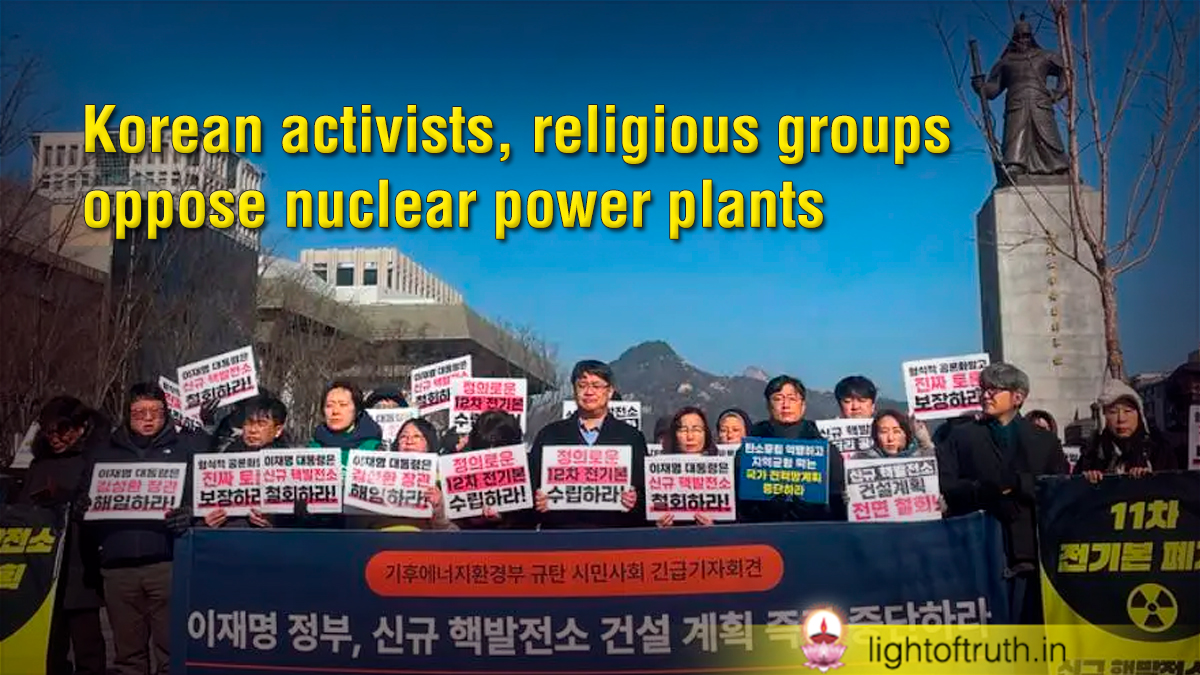
Civil society and religious groups in South Korea have continued their strong opposition to two proposed nuclear power plants, accusing the government of moving ahead hastily without sufficient access to information, deliberation, or consent. During a press conference on Jan. 27, the Citizens’ Action for Nuclear Phase-out, a coalition of 43 environmental, advocacy, and religious groups, slammed the government for its planned nuclear plants, according to a report by the advocacy group People’s Solidarity for Participatory Democracy.
“We strongly condemn the forced push for the hastily pursued new nuclear power plant construction plan,” said Esther Yoo, an executive committee member of the Nuclear-Free Citizens’ Action group. Yoo also demanded that South Korean President Lee Jae-myung “dismiss Minister Kim Sung-hwan and personally explain the [purpose of the] new nuclear power plants.”
On Jan. 26, Kim, the Minister of Climate, Energy and Environment, stated that the government would proceed with the construction of two new nuclear power plants, the Asia Business Daily reported. Kim hinted at the possibility that the proposal for additional nuclear power plants remains open in the 12th Basic Electricity Plan, which will be prepared this year.
A public opinion survey found that more than 80 percent of respondents said nuclear power is necessary, and over 60 percent agreed that the new nuclear power plants were essential, according to the government.
Park Hang-joo, a specialist committee member of Green Korea United, condemned the survey as “ridiculous.” He pointed out that the survey methodology was flawed and the questions “failed to verify the consistency of the entire survey and responses for policy decision-making.”
Lee Heon-seok, a policy committee member of Energy Justice Action, warned about the risk of nuclear power plants clustered together near cities. “In the event of an accident, the risk is enormous, and evacuation is completely impossible due to the dense concentration of major cities nearby,” Lee warned.