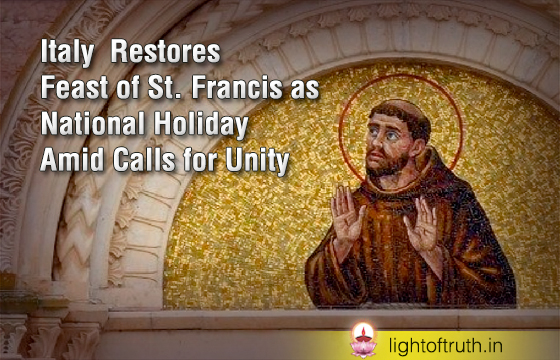
On October 4, Assisi will once again become the beating heart of Italy’s spiritual life. This year’s feast of St. Francis, already a fixture of the Italian calendar, takes on a heightened significance as the government moves toward recognizing it as a full national holiday. Prime Minister Giorgia Meloni, accompanied by Minister of Culture Alessandro Giuli, will join pilgrims and church leaders in the Umbrian town for the annual liturgy and civic ceremonies. The timing is striking: just days after the Italian Chamber of Deputies overwhelmingly approved the bill to establish October 4 as a new public holiday in honour of the country’s patron saint. The measure now awaits approval by the Senate, with full implementation expected by 2027.
The initiative carries more than symbolic weight. Declaring a thirteenth national holiday means changes in labour contracts, wage supplements, and state spending to cover essential services on the new day off, projected at more than 10 million euros annually. Yet lawmakers across the political spectrum have backed the idea, seeing in Francis of Assisi a figure whose legacy transcends religious affiliation. In a time of cultural divides, the saint of peace, fraternity, care for creation, and solidarity has once again been cast as a unifying emblem of Italian identity.