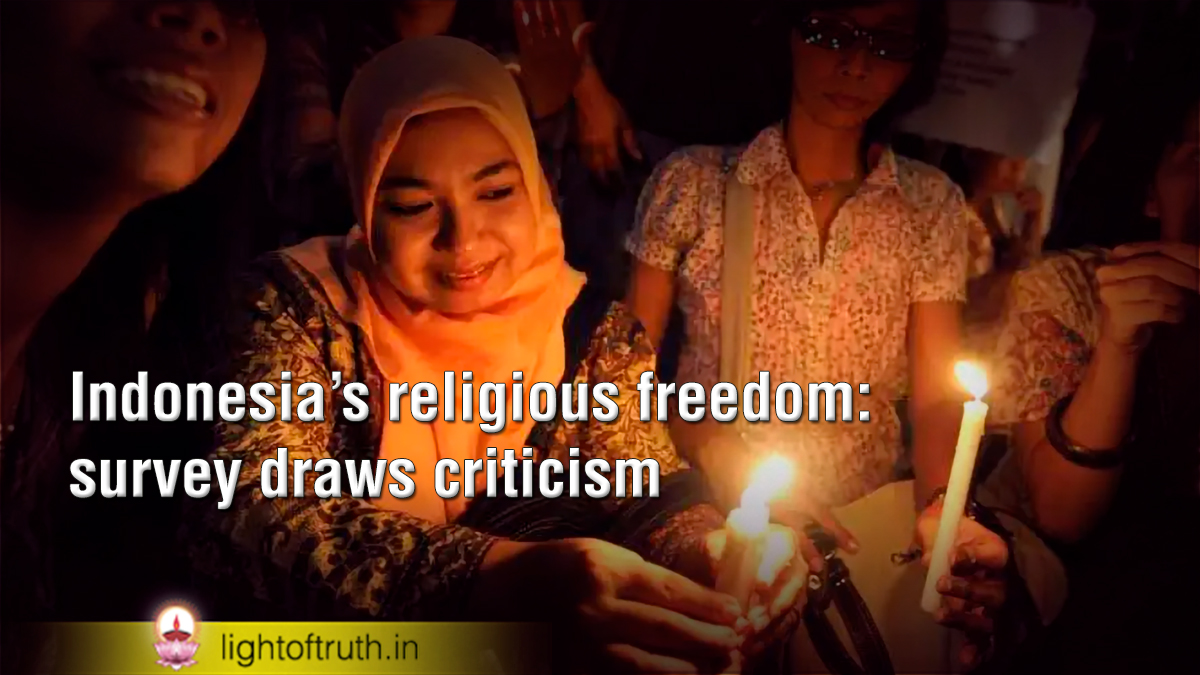
A recent nationwide survey claiming a whopping 97 percent of respondents believe they enjoy freedom to practice their faith has raised eyebrows in Indonesia, with critics saying the findings are far removed from reality.
Lingkaran Survei Indonesia, a survey and political consultancy institution, released the results of its “Public Evaluation and Commitment to Pancasila” survey on April 12. Pancasila, Sanskrit for “Five Principles,” refers to the national ideology of the world’s largest Muslim-majority nation. The principles are belief in one God, civilized humanity, national unity, deliberative democracy and social justice.
The survey was conducted from March 4 to March 12 among 2,020 people aged 17 and older. It found that 56.6 percent felt “very free” in terms of religious freedom, while 40.7 percent felt “quite free.” Only 1.1 percent felt “less free,” 0.5 percent considered themselves “very unfree,” and 1.1 percent were unsure.
However, critics questioned the survey’s methodology, noting that 87 percent of respondents were Muslim, about 10 percent Christian and the remainder belonged to other faiths. They say rising religious intolerance and repression of minority faiths in Indonesia have become causes for serious concern. Ethnically, the survey included 40 percent Javanese, 15 percent Sundanese, with the remainder made up of Batak, Madurese, Betawi, Minang, Malay and other groups.
About 87 percent of Indonesia’s estimated 287 million people are Muslim, 11 percent Christian and the rest belong to other faiths, including Hinduism and Buddhism, according to official data. The 2025 report from the US Commission on International Religious Freedom painted a troubling picture of religious freedom in the country.
Indonesia’s religious freedom conditions are poor, the report said. Despite constitutional protections for freedom of religion or belief, the Criminal Code and other laws restrict worship, targeting religious minorities such as Protestants, Catholics, Ahmadiyyah Muslims, Jehovah’s Witnesses and Baha’is. A new Criminal Code took effect in 2026, broadening the criminal definition of blasphemy, the report said. Religious minorities also face challenges in constructing places of worship, as local authorities often refuse to issue permits.
Bagus Sudarmanto, a senior lecturer at the University of Indonesia and a journalist, urged caution in interpreting the survey results. “The results of this survey must be read with great caution, as they are highly subjective and do not reflect the true reality”.
“The majority group dominates the sample, and this has the potential to obscure the experiences of minorities. Perception-based survey questions are also susceptible to social bias, especially when face-to-face interviews are involved”.
He said indicators of religious freedom in Indonesia “have not been tested against concrete cases of discrimination.” “These results reflect a subjective sense of security, not the actual structural conditions of religious freedom in Indonesia.” He called on researchers to be transparent about regional distribution and the context of local conflicts so that “their interpretations do not mislead the public.”