- Prema Jayakumar
March and April are full of festivals across India. Most states have their own festivals, most of them either celebrating the harvest or the beginning of a new year by one of the innumerable calendars. Ugadi, Gudi Parwa, Chaitra Navaathri, and of course our own Vishu, the Bihu of Assam and many others. And across India two festivals are celebrated by larger sections of people than these state-specific festivals. I am talking of the Eid after the month of Ramdan spent in fasting and Easter which follows the austerities of Lent. What all these festivals have in common is the theme of rebirth, getting in touch with the divine in you, leaving behind the mistakes of the past and going on to a new year, a new beginning.
Every year, one feels that it is impossible to talk of hope and beginnings in a world we live in. It is difficult to talk of new beginnings in a world that seems set on destroying itself. It does not seem to be in a state that could be celebrated even by those who have immense faith. Perhaps you could pray that human beings, who possess the power of discrimination, would come to know when violence is needed and when it is not. Even when they demonstrate again and again that they do not. There are so many wars being fought. We were told the war between Russia and Ukraine would end in days. Then the days lengthened into weeks, months and now, years. Of course the area around the Persian Gulf had many conflagrations going on for years and years. Old grudges, hurt egos of rulers, disputes over religion and religious practices, naked land grabs, anything would serve as a starting point. And now, a war that seems to make no sense at all except that it is killing a lot of people, destroying a lot of infrastructure that cost human effort to build. All these are costing immensely in terms of lives, children losing the opportunity to live a life that children should, lands becoming uninhabitable because of triggered mines and bombs which have not degenerated. One can understand fighting over territory however futile it seems later, but a fight with some unclear aims and confused rhetoric seems beyond the capacity of our minds to grasp information.

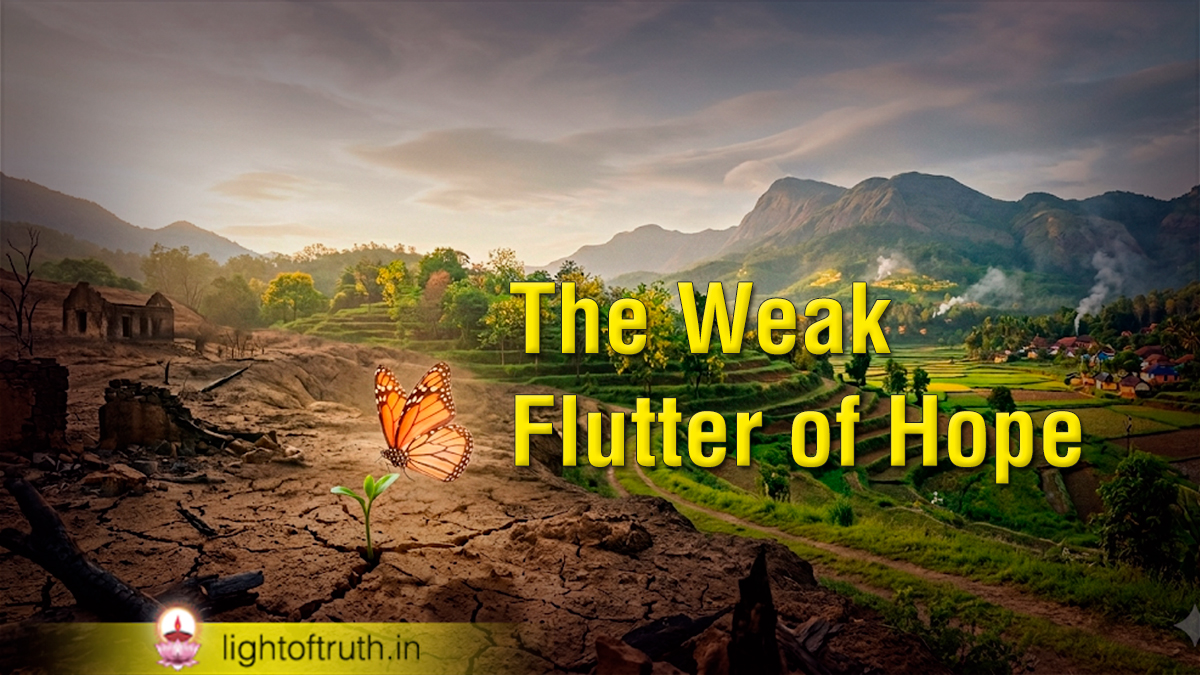
“…Hope is something more nebulous, something delicate like the wings of the butterfly. It is not rooted in experience or expectation… It is Vaclav Havel who said, ‘Hope is not the same thing as optimism. It is not the conviction that something will turn out well, but the certainty that something makes sense, regardless of how it turns out.’ …because the human being cannot live without hope.”

And yet, even in this world that we cannot make sense of, we celebrate our festivals, we offer up prayers without words, we believe this world will right itself. It is not that we believe that the killing will stop and that swords will be turned to ploughshares all at once. It is not even a sense of optimism. It is something beyond that. Optimism has to base itself on something concrete, some signs that life will be better, more sensible, soon. But hope is something more nebulous, something delicate like the wings of the butterfly. It is not rooted in experience or expectation. It is a kind of faith in the essential logic of the world. It is Vaclav Havel who said, ‘Hope is not the same thing as optimism. It is not the conviction that something will turn out well, but the certainty that something makes sense, regardless of how it turns out.’ It is difficult to believe in anything makes sense when war is made on children.
But, we still hope. Because the human being cannot live without hope. It has to hope, to believe. That when the evils imprisoned in Pandora’s box have been let out, a flutter of weak wings will be heard, that the tiny butterfly of hope will come out of the box and let humanity live even when life seems impossible.
Isn’t it a wonder that hope does ‘spring eternally’ even in the worst of circumstances? That one can forget grief and hope? The poet Sugathakumari said it in her poem:
Oru tharakaye kanumbol athu/ Ravu marakkum.
Puthumazha kanke/ Varalcha marakkum.
Palchiri kandathu/ mruthiye marannu sukchiche pokum/
Pavam manava hrudayam.
(It forgets the night at the sight of a star.
It forgets the drought at the first rain.
It forgets death at the sight of a child’s smile and starts rejoicing.
The poor human heart).
And we are human. So let us hope for a rebirth, for new beginnings, for renewal.