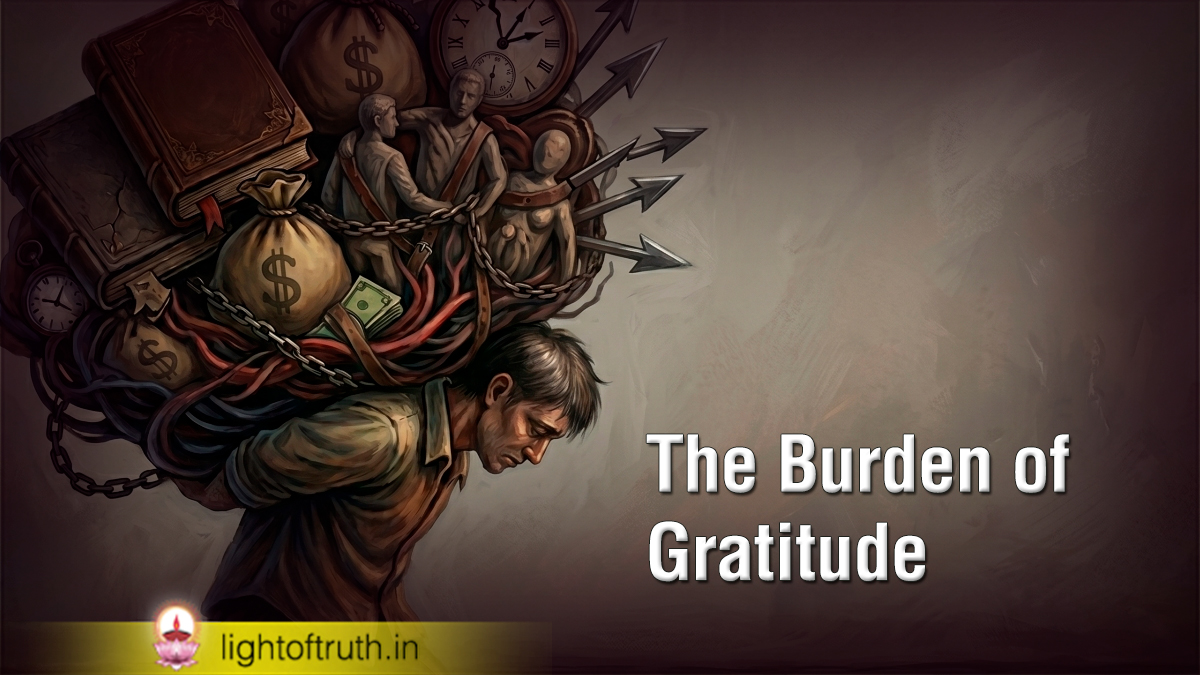
- Prema Jayakumar
 ‘Why does that man hate me so much? I don’t think I’ve ever done him any favours.’ This is a quote (verbatim) from a political leader of a previous generation, one of whose party members had tried to sabotage his election. But it opens up a very interesting psychological phenomenon. Because it acknowledges the truth that an abundance of generosity could breed enmity that benevolence lays a burden on the receiver, a burden that is resented and might even turn the person who benefited from it into an ill-wisher.
Cicero said that ‘gratitude is not only the greatest of all virtues, but the parent of all.’ Everyone is sure of that. The Bible exhorts us to ‘be thankful’. Shakespeare asks ‘for a heart replete with thankfulness.’ Everyone is sure that gratitude is a wonderful virtue, and no human being is a real human being without that virtue. Then why is it that a long period of having to feel gratitude becomes a painful duty? And having to receive it constantly is a chore.
Among the moderns I remember only Faulkner saying it clearly, ‘Maybe the only thing worse than having to give gratitude constantly all the time is having to accept it.’
All around us, we constantly hear the lament, ‘I’ve done so much for him. He’s absolutely ungrateful. Finds it difficult even to acknowledge me when we meet.’ It hurts to be ignored by someone you helped. You know, ‘How sharper than a serpent’s tooth it is to have a thankless child.’ Of course the child can be paraphrased into any other noun.
Anyone who’s done favours for, given money to or otherwise helped people, would remember the ones who acknowledged them, who did not find the gratitude that they felt was a burden. And they would also remember the ones who, while being polite on the surface, even acknowledging a debt, seemed to be carrying a hidden resentment even if the benefactor did not say about earlier largesse. It is difficult not to be hurt when this resentment shows in small ways because, you originally did the favour, gave the gift, because you were fond of that person and genuinely wanted to help. This might be true even of one’s own children. One remembers the sacrifices made, the nights spent sleepless, the care taken to give them what they liked, be it food or sports or entertainment. They may be good to you. But they don’t remember the incidents from their childhood with the same intensity as their elders. And would see no reason to keep reiterating how grateful they are.
I have always felt that the burden exists because neither the giver nor the taker can really forget the transaction. If one could just give and then forget about it, and not remember the gift each time we meet the person who benefited, the burden of gratitude might become lighter. The one who received might also be able to forget the weight of the favour and be able to see the person at the other end as the nice uncle or aunt or friend of whom he was very fond.
But it is true that a having to remember favours, even life-changing gifts, can become a burden. One is so aware of the person who gave as a personification of the gift, rather than an individual. Maybe if the giver can forget the gift the beneficiary can also forget it.
Still, there are people who prefer to remember past generosity with pleasure, and hold on to the debt purposely to keep that feeling. I remember an incident at my uncle’s funeral. One of his friends, a fairly rich man, had come to visit. He narrated an incident when my uncle gave him a hundred rupees at a point in his life when that amount was essential. The incident happened at a time when they were both young and hundred rupees was a big sum. They had both moved on. What he said at the end stayed with me, ‘I could have repaid him with ease after some time. But I preferred not to. I wanted to hold on to the gratitude I felt when that money had been given.’ For all the ungrateful ones, there are also people who remember past gifts with pleasure.