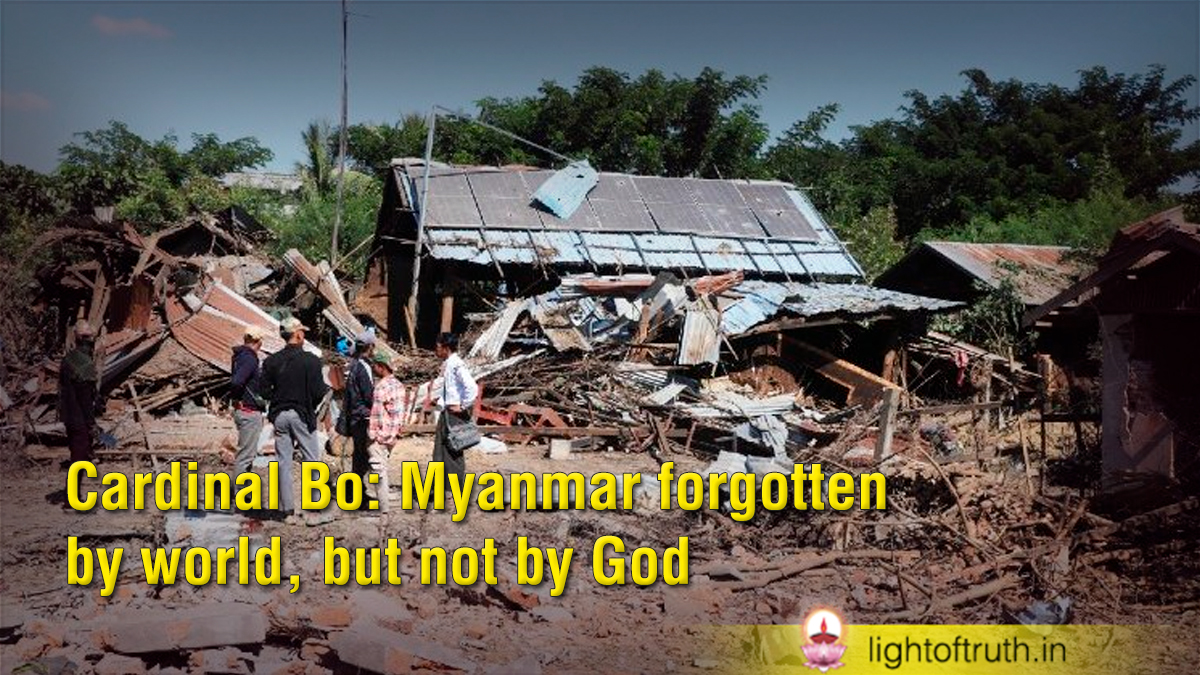
Cardinal Charles Maung Bo, Archbishop of Yangon, has repeatedly warned that “Myanmar is going through a ‘polycrisis’: an economic crisis, with rising prices; a crisis due to the loss of job opportunities; a social crisis, with more than 3.5 million displaced persons and young people fleeing abroad; a crisis of basic health care; and a crisis of education, with a generation that has lost five years of schooling.”
Sharing with Vatican Media the dire situation facing the country, the Cardinal described Myanmar, five years after the military coup, as a nation marked by fear, exhaustion, and deep uncertainty, especially among young people. Yet, he observed, while hope is “not dead,” it is “crucified.”
Cardinal Bo acknowledged that the general mood among the population is complex and varies according to personal experience, geographic location, and proximity to violence.
Among young people in particular, the Cardinal noted, daily life is increasingly defined by insecurity, psychological strain, and a loss of trust in the future.
“Young people are living with near-constant fear for their personal safety,” Cardinal Bo explained, pointing to ongoing conflict, widespread violence, economic instability, and the threat of forced recruitment. This prolonged insecurity, he said, has led to rising anxiety, stress, and psychological pressure among youth across many regions of the country.
Cardinal Bo also decried a deep sense of loss, observing how years of disruption have eroded education, employment prospects, and normal social life. Many young people, he said, express frustration, sadness, and helplessness, with surveys showing sharp increases in anger and emotional distress compared to the years before the coup. “Very few still experience any sense of normalcy,” he noted, adding that a growing number of young people are considering leaving Myanmar, or have already done so.
At the same time, Cardinal Bo cautioned against reducing Myanmar’s youth to victims alone. Even amid hardship, he observed signs of resilience and determination. Some young people continue to believe in the possibility of a better future, investing in education and new skills, including digital technologies, in an effort to create opportunities against extremely difficult odds.
Against this backdrop, Cardinal Bo insisted that hope remains possible. “This is not naïve optimism,” he said. “It is a Christian hope born of the Cross and Resurrection.”
This hope, the Cardinal explained, does not rest on circumstances or political calculations. “The people of Myanmar have lost many securities—peace, livelihood, stability, even international attention—but,” he noted, “they have not lost God’s presence.” That presence, he said, is visible in displaced villages, in camps for the internally displaced, and in the quiet endurance of families, mothers, catechists, and religious who continue to serve amid suffering.