Fr Biju Savio CMI
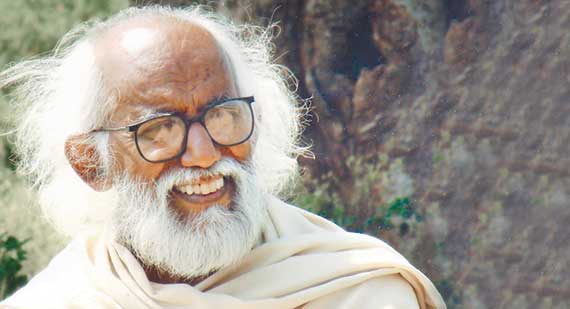
Here in Jerusalem, staying between the two empty tombs-one of Jesus in the Holy Sepulchre Church and the other of Blessed Virgin Mary at the foot of the Mount of olives- I reflect on the life of Rev. Fr Michael Purattukkara CMI, lovingly called Swamiyachan who never wanted a tomb of his own after His Lord and Guru. He died on 25th April 2016 when he was on a journey away from his Ashram undertaken in the hot summer of the North India to visit two persons unjustly remanded to the judicial custody for a long time and to procure bail for them. After visiting the prisoners, he proceeded to Sendhwa (near Indore, M.P). He gave a motivational talk to differently abled children in an institute run by Augustinian Sisters there, sang bhajans with the children, and went to take rest for some time after the lunch, as he was tired. When he was not seen for the next class, sisters went to call him but found him dead due to a massive heart attack. During his funeral service, one of the Augustinian sisters had recalled that Swamiyachan had arranged a solar system for the children over there through some volunteers and that they had the news of sanctioning of their project for the disabled children on that day. The CMI religious authorities respecting his written desire, donated his dead body for the purpose of medical training to the nearest Medical College at Bhopal (AIIMS, Bhopal). He may be the first Catholic priest in India to do so. After the funeral services, presided over by Bhopal archbishop Leo Cornelio, Swamiji’s body, bare footed and clad in his usual attire of saffron dhoti and a mere shawl on the upper part of his body was handed over to the hospital authorities. During his final years of life, Swamiyachan had undergone bypass surgery for the heart. But that in no way slowed down his commitment to the cause of the gospel of Jesus Christ. Throughout his life, he always served the Lord even disregarding his own comfort and basic needs. So donating his body to a medical college completed his lifelong selfless service. He doesn’t need his body until the Lord makes the heavens and earth new. Then it will be transformed. Swamiyachan wanted to make his dead body useful to the world. Who can think of donating his dead body except the one who has achieved a great sense of detachment in the service for the kingdom inaugurated in the resurrection of Jesus? In the Bible, some people who walked with God so faithfully have no tomb. Enoch walked with God; then he was no more, because God took him (Gen 31:24). According to a Jewish tradition, God buried His servant Moses whom He knew face to face (Deut 34:10). So nobody knows about the tomb of Moses. God took the prophet Elijah to Himself in a whirlwind. Elijah too has no tomb!!! Both Moses and Elijah are considered prophets who died in the hands of the Lord. So these two prophets, Moses and Elijah were with Jesus on the mount of Transfiguration discussing with Him of His Exodus, His Passover (Luke 9:31), His death-His submission of his spirit into the Hands of the Father (Luke 23:46).
As we approach the first death anniversary of this great prophet and rare religious priest of our times, one is faced with a challenging thought – Swamiyachan has no tomb!
In a world where Resurrection of Jesus is mostly understood as an escape from death rather than as conquering death and all the powers that depend on it, Swamiyachan stands as a prophetic witness to the Resurrection of Jesus and for the new creation it initiated. His whole life was marked with an outstanding compassion, passion for justice, reverence for nature, and union with God in Jesus. He was unique and prophetic in his life and death and continues to be so even after his death. Even as a student to priesthood, Swamiji opted for a simple life along with some other seminarians. They led a very simple life, cooking their own simple and vegetarian meals. He went for work with the daily labourers to have a firsthand experience of their problems and hard life. Swamiyachan always held every work in high esteem and was willing to do any work in the service of the other. When the members of the CMI Devamatha Province were entrusted with the Sagar mission area (M.P), it was entirely a new beginning with real cultural challenges. This challenge called for a complete immersion in the north Indian cultural and religious horizon to sow the seeds of the gospel. It was a demanding challenge to which Swamiji responded very heroically and fundamentally. Drawing his inspiration from a deep life of prayer, Swamiji in his person synthesized the ideals of Indian sanyasa, Carmelite interiority, and the challenging demands of the radical discipleship of Jesus.
One of the rich spiritual experiences Swamiji had was while walking from Tada to Siermeau on a fine morning. He proceeded from Tada early morning to reach for a meeting at Siermeau. On his way through the hills, he was deeply touched by the beautiful blade of grass, the kissing of the dew on the petals, the all pervading and caring of Mother Earth. He left the slippers and stood on the ground to experience the soothing touch of Mother Earth. He was immersed in praising God for the gifts of Mother Earth and for the products that come out of her. The pain and agony that Mother Earth undergoes filled his heart with indefinable pangs. It led him to a deep contemplation of God’s beautiful creation. As the sun was about to set, the shepherd boys looking after the cattle were returning home! They saw a man lost on the hill, alerted him to proceed further since it is dangerous when it gets dark. Swamiji was shocked to see that it is getting dark. He had lost his direction as he underwent this experience and hence asked the way to Siermeau. The shepherd boys showed him the way and he proceeded. It was already night when Swamiji reached Siermeau. The effect of this mystical experience remained with him for the whole night. Swamyachan decided to walk barefoot then on and remained so until his last journey to the AIIMS Bhopal where his body is kept and used for medical training. The earth is no more viewed as wicked evil that will be destroyed but as God’s sanctuary which will be transformed into a new earth along with a new heaven.
Swamiyachan undertook many successful social interventions against the oppressive caste system in the villages of M.P. Just as the prophets of the eighth century B.C. left their villages and carried their “thus saith the Lord” far beyond the boundaries of their home towns, and just as the Apostle Paul left his village of Tarsus and carried the gospel of Jesus Christ to the far corners of the Greco Roman world, so was Swamiji compelled to carry the gospel of freedom beyond his own home town (Ollur, Thrissur-Kerala). Swamiji identified himself with the poor and the suffering. Swamiyachan realized early in his life that injustice anywhere is a threat to justice everywhere and whatever affects one single suffering person directly, affects all human race indirectly because of our interconnectedness. Once, identified himself with the suffering of the oppressed, Swamiyachan never hesitated to act for the cause of the poor. He understood that creative and salvific involvement of God in the person of Jesus calls for an active participation of such mission by using the time constructively. Often the naïve optimist sits back in idle laziness thinking that time will cure all ills or else he waits passively for the Lord’s return to get everything right on track. This does not correspond to the Christian ideal of God’s creation and salvation. Swamiyachan’s social involvement and his commitment to the cause of the poor did not go well with the people who wanted to oppress the poor people for their selfish and institutional interests. The strong oppressive minority had the support of the powerful institutional elements in the society. There were many attempts to kill him on those days. As Swamiji continued his mission among the poor, the opposition too increased. One day a group of 4 youngsters, came to Guru Nivas Tada, when Swamiji was alone. They came and knocked at the door. Swamiji opened it. There were four strange men. One of them pushed him to the floor. Swamiji got up and enquired about their purpose coming. They plainly told him “ we want to kill you.” Swamiji suspected that they might have been hired by the local leaders to attack him. At this juncture, he began to feel insecure. Swamiji requested them to give him some time to write his last will. Swamiji wrote in a paper his will as follows “I am going to be killed for the sake of the poor and downtrodden people of the area. No case shall be registered against those involved in my killing. Let my death enrich the poor people who are struggling to live in this unjust society.” After writing the last will, he entrusted the paper to one man among them. One who read the last will written by Swamiji realized the pure intention of Swamiji. He said, “Let us not attack him. He is not an ordinary man.” Other members of the group, also, got convinced. Thus the undesired incident did not take place. They all went back by bike on which they had come to Guru Nivas. Swamiji always remembered this incident as a moment of God’s mercy extended to him.
The gospel of Christ made inroads to numerous persons in Narsinghpur, (M.P) when swamiji spent his life in Saccidananda Ashram. The Ashram grew up by enhancing support and cooperation from the local people. The impact of the Ashram can be assessed by its various activities focused on Inter-religious dialogue, Indian spirituality, and developing Indian liturgy. Swamiji initiated a fellowship of various organizations and people of all castes and creed to work for the peace and harmony. This fellowship was gradually evolved into an organization called “Samanvaya Parivar” (Fellowship for harmony).
When Swamiji was in Narsinghpur Ashram, he adopted a simple dress of an Indian sadhu. Then on Swamiji wore only a dhoti and a shawl. He, mostly, travelled in the unreserved general compartments of the trains with the poorest of the society. The Christian missionary in this simple dress with a broad warm smile became the face of Christ for numerous people that encountered swamiji thereafter. Along with the change in the dress swami also changed his name into Sadanand. For him, the name was significant as it contains both sadness (sad + ananda) and happiness, as every life is a mixture of joy and sadness. It signifies the totality of life, the orientation, struggles and moments of happiness and grief. Swamiji used to say that we are to be like a dustbin in the society. People might throw at us what they don’t want in them. But we accept it with grace and forgiveness and it would make this world cleaner and happier. Swamiji remained true to this vision at the face of personal allegations and misunderstandings. He never kept a personal grudge against anyone even when he opposed the oppressive structures. He was always the first one to go out of his way to help with a warm smile when he knew that the people who treated him badly are in need.
Swamiji was a real prophet of reconciliation of his time. There are numerous lives he has touched with his ministry of reconciliation. There is a very significant case of reconciliation led by Swamiayachan among the Hindu fanatic groups and individuals who fought with each other on the issues of the properties of the famous Narsingh Temple in Narsinghpur city. Those were old and new groups which involved in the financial and temporal management of the temple. They clashed with each other over the right to the temple and its succession. The conflict reached its heights with unending debates and group fights. The district administration stood helplessly and caught between the conflicting groups and was hesitant to take action at gunpoint or arrest the leaders. The district Magistrate took the issue to Swamiji to avoid the dreaded conflict in the society as they stood with weapons to fight it out. Swamiji assured peaceful settlement of the issue and intervened with dialogue, group visits, and meetings of religious leaders. The temple priests were sceptic about solving the problem. It took two weeks to resolve the issue and to bring the two warring groups face to face ending all disputes.
Swamiji’s ministry of reconciliation also brought about the conversion of Samandar Singh, the one who killed Sr Rani Maria FCC. As is well-known to you, Samandar is now a totally new man and is a witness to the world of the power of true forgiveness and reconciliation.
Swamiji had the habit of getting up as early as 2.30 am and used to spend time in prayer and meditation before the celebration of Holy Eucharist. His deep prayer life, austerity of life, simple life style and warm personal relationship imbued with a spirit of genuine service touched the hearts of everyone who met him. Once, Mr Tulsiram Nema, a well known and accepted Professor of the Narsinghpur town exclaimed “YOU ARE A PARAS PATHAR” – a stone by the very touch of it turns everything to diamond and gold. He was light to the world and salt of the earth. Swamiji worked miracles in the hearts of many and continues to challenge our small comfortable world to translate the power and mission of the Risen Lord in these difficult times.
Jesus becomes so real to anyone against the background of the life witness of Swamiyachan. There was a prophet among us.