When is your ordination?
My ordination is on 23rd of April. On that day we have the feast of St Thomas the apostle, a major feast coming after Easter.
What is the motto that you want to take?
The motto I have taken is ‘What all you need is my grace’ from 2 Corinthians 12:9.
When St Paul the Apostle realized that his imperfections and immaturities might be obstructing his ministry, he feels Jesus is present in those moments of weakness enabling to strengthen him. I also feel that in my moments of weaknesses and imperfections God will be there to strengthen me, and that’s all what I need. I cannot claim to be perfect. Even with my imperfections, I should be able to give myself as a human being and also to help other human beings who are imperfect.
We speak very often about grace? What does grace mean to you in your priestly life?
For me grace is the limitless and unconditional love of God. I am more than what I do. That’s the message that I often get from my biblical reflections, because God is valuing me more than my activities, more than what I do. My being is very precious for Him. That awareness and experience of God valuing me more than what I do, is what I see in the Episcopal nomination also. I was not expecting it at this age, but then, suddenly, it has happened because God has some plans beyond what I think. God is sometimes not taking seriously what we do or what our sins or our imperfections are. God values us in spite of them.
Do you connect that grace in your interiority?
Yeah, all through my life I can see that I was not sure about many of my choices. But still God has worked wonders through all those choices. The ministry of counselling that I am doing now also is part of that. As diocesan priests, we may not consider it very significant, but I think God has made me an instrument in doing many things in that field too. In the future also I think God will surprise me with that grace.
You are going to be the auxiliary bishop of Changanacherry archdiocese. Of course, you may not have the freedom to do whatever you like. But what will be the general orientation of your pastoral ministry?
As the auxiliary bishop, the only thing that will be asked of me is to assist the archbishop in executing the policies of the archdiocese. Our diocese is very vast and we have three forane districts in the mission area. I am supposed to be in the special charge of those foranes of Trivandrum, Kollam and Amboori. In those areas we have many opportunities for missionary work. We need to cater to the pastoral needs of the people there. So what I will be focusing on is an effective pastoral ministry for those who have not had it. My major concern will be to be with my brother priests. We need to have a better coordination of all priests. We have around 470 priests, quite a big group. If we can give some personal care to our priests, that will be of great service to my apostolate.
Changanacherry is a traditional Catholic belt; what do you think is the most urgent priority that you must address?
The challenges of secularism are everywhere. I think they are attacking all the traditional institutions of the society. We are also struggling to keep our values intact. I often say that I have only half the faith of my parents and my children will be having only half of my faith, and so, when the generations pass on their faith to next generations, the intensity of the faith experiences diminishes. Many of our people are working abroad as migrants. I had some occasions to be close to their lives. I have realized that in their families sometimes these traditional family values of prayer, being together, eating together and such occasions are decreasing due to job pressure etc. Youngsters, perhaps for no fault of theirs, fail to give importance to spiritual life. That can be a major challenge.
There are different ways of looking at things. Some may see it as diminishing of faith. It can be seen in another way. Every generation has a different way of living its faith. Forms of faith may differ. For example, we may say that the Church is disappearing in Europe, but it may be actually taking a different shape. Could that be the case here also?
Because the Church and its structures are changing, attitudes need to change. Sometimes we cannot change our faith or principles of faith, but the ways of communicating them can. We should be so strict and rigid about our heritage as to force it upon the new generation. I think we need to be more merciful to their situations, because our families are very insecure and our children are looking up to us also for a merciful and considerate approach. They don’t want a policeman type of pastoral ministry any more. They are not ready to respect such people.
In our own traditional families we lived totally in an agrarian system. It is now totally changed. It is a technological society where people are uprooted. Technology makes you a globalized citizen. In that globalized world, what is the real challenge we are facing?
In such a society our expectations of this generation might be quite different. Their spiritual life may not be up to our expectation, still we have to accompany them in their struggles, we have to open new ways of pastoral ministry to cater to the needs of the youth. For example, we have to make use of all the technological advances for the ministry. Our primary aim is to reach the ends of the world with the Word of God. For that we have to use all the technological means. As you said, this technology is uprooting people, making them feel more and more lonely in this world. That is a major concern. A Church which can address the loneliness of the new generation will be able to help them a lot. We always judge them as people lacking faith, but they are actually lost in a technological world and experiencing a kind of loneliness, which we have to address. We need to accompany them not only spiritually but also psychologically in the light of our Christian faith.
A question very pertinent to our Kerala context is that in this secularized and modernized technological era, what seems to be dying away is certain forms of religious life. For example, at least in Ernakulam many of the convents may be getting closed after fifteen or twenty years. Don’t you foresee this crisis? Does it not require some sort of a restructuring of the whole existing system of the Church?
Vocations of women are decreasing to religious life. We say we still have vocations to religious life among men. But if we closely analyze the statistics, men are drawn not to religious life but to priestly life. Priesthood is attracting them more. We have to study more about it. Even now vocation to religious life is more for women than men, because Brothers’ congregations and orders are dying down. No one wants to be a religious Brother, everyone likes to be a religious priest. We need to look into why sannyasa as a good way of life is dying out among men.
Don’t you think the paradigm of religious life itself is changing? There may be new paradigms and therefore we are seeing certain things crumbling down, preparing the way for some other thing to emerge?
I feel that in the Indian context religious life is still honoured and respected, and unlike in Europe, it will always find a place here. I would say, thanks to the Indian culture, religious life is more respected here among the Hindus. Many people are joining religion, and even now these religious values are existing, but we need to facilitate them in a different way. For example, now a days, religious congregations are giving more importance to the role of identity than to their core identity. They are simply equating their religious life with the apostolic works that they do. Apart from the real contemplative religious life they highlight the apostolate that they are doing, and now the relevance of those apostolates is dying down, because everyone can run school, hospital etc. So it is not the problem with the religious life. Religious values are still attractive to people. One of the major superiors of the major congregations running schools, colleges and hospitals was telling me that the young priests don’t want to get involved with any of the institutions. They want a pure religious life. Such a thirst is growing among at least a minority. I would say that we need to deepen our religious life rather than changing religious life.
The whole world is turning to some sort of fundamentalism and religious fanaticism. In Islamic world, Hindu world and even in Christianity there is some sort of extreme rightist movements coming up. Don’t you think this is also a threat in the present world in which we live?
May be from my psychological background I would say that the basis of all fanaticism or such a rigid mentality is the basic insecurity we feel in the world. In the major Christian countries they have ensured a kind of security for the people and these things are disappearing. If we take our Christian community, we have been teaching people religion for a long time very systematically, but our children are not drawn to terrorism or fanaticism because we have been consistently teaching them to love. When that is lacking or when religions exist just for keeping the structure this fanatic thinking will emerge. Otherwise, if we base ourselves in the basic teachings of Jesus Christ, I would say it will not be a big problem. Also, we need to look into the problems of our people and we need to address the basic issues of the insecurity.
There is always a tendency to find some sort of security in the past. Look at the slogan that the Hindutva people designed Ghar Vapsi, which means going back to history and finding some sort of a security in the past. The same thing is happening in Islam by going back to their caliphate. That kind of a returning into one’s own past is a tendency that can affect everyone. Don’t you think this is also a problem that we have to reckon with? As Christians we are the people who march onwards to the future as Moses led the people through exodus. Is that exodus or a return that plays very major role in our life now?
Sure, we are always marching ahead and we are leading our people to an exodus, but without forsaking the basics. Rather than returning to the past, I would say that we need to hold on to our basic things. It is remembering the past. Without losing our basics, we have to lead our people otherwise our identity and our mission will be lost.
You have been trained in psychology and how do you relate your psychological studies to your faith?
I always tell my students also that psychology is helping me to be more merciful towards myself and to others. A person who has learned good psychology will never label others as people who have one problem or the other. S/he will learn to be merciful and considerate towards oneself and to others. That is the connecting link between psychology and faith. If we simply limit our faith to the revealing God alone, I think we are missing a major point. The person who is receiving also has to be taken care of; not only the God who reveals, but the human person who receives.
Are you alluding to the frailty of man?
Yeah, the frailty of man and the human struggle to relate to God need to be addressed. In such a context, I would say that psychology can help a lot in deepening a secure relationship with God by understanding this human struggle to follow God.
Does psychology help you to give an expression to your faith by understanding the interiority of person; struggles, agonies and frailties of person?
Yeah, sure. I have an experience of counselling many people in the last six years. After listening to every human story, I only grew in respect towards them.
In that respect, how do you see the present Pope Francis? Do you think he is man of great understanding?
He is deeply spiritual and biblical I would say. Biblical because he is trying to see people from the perspective of Jesus Christ. Jesus has related to them by sharing their struggles. Pope is also doing the same. People, as if they are thirsting for that approach, are all around him. That is my impression.
What is it in Jesus that endears you most?
Jesus considers the person of an individual more than what s/he does. For example, take the case of the woman who sinned. Everyone judged her to be an adulterous. Even in our time people might judge her as one who cannot be admitted to the church. But how Jesus has won over her and how much goodness has come out of her after that. Such an approach has touched me a lot. I have often felt that we have not succeeded in understanding the multiple structures of the gospel. We are still giving importance to the punishing God rather than to the merciful God.
What do you pray and how do you pray?
My prayer is more of a meditative one. I meditate on the Jesus who is gazing at me with a lot of mercy and love. When I concentrate on that, self-esteem grows and my mind is filled with happiness. I pray daily, ‘Kindly make Your merciful face more and more visible to me.’
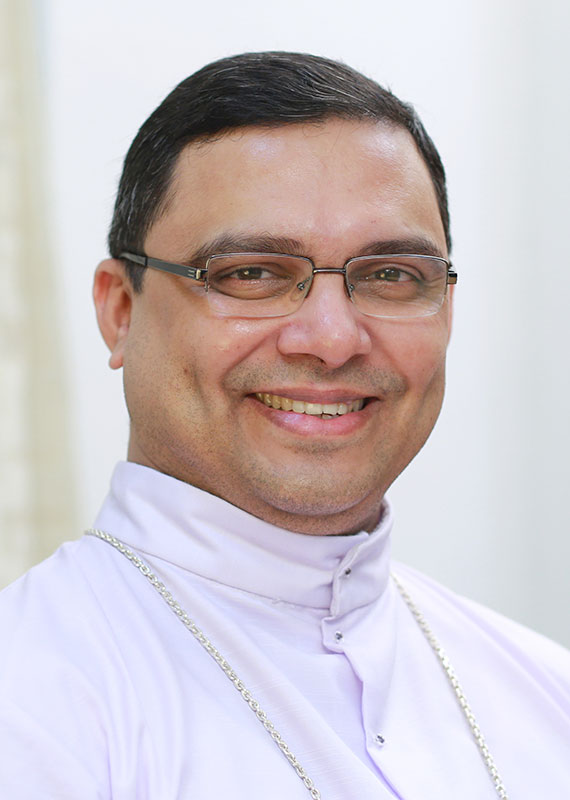
Bp Tomy Tharayil
Auxiliary Bp of Changanacherry