- Valson Thampu
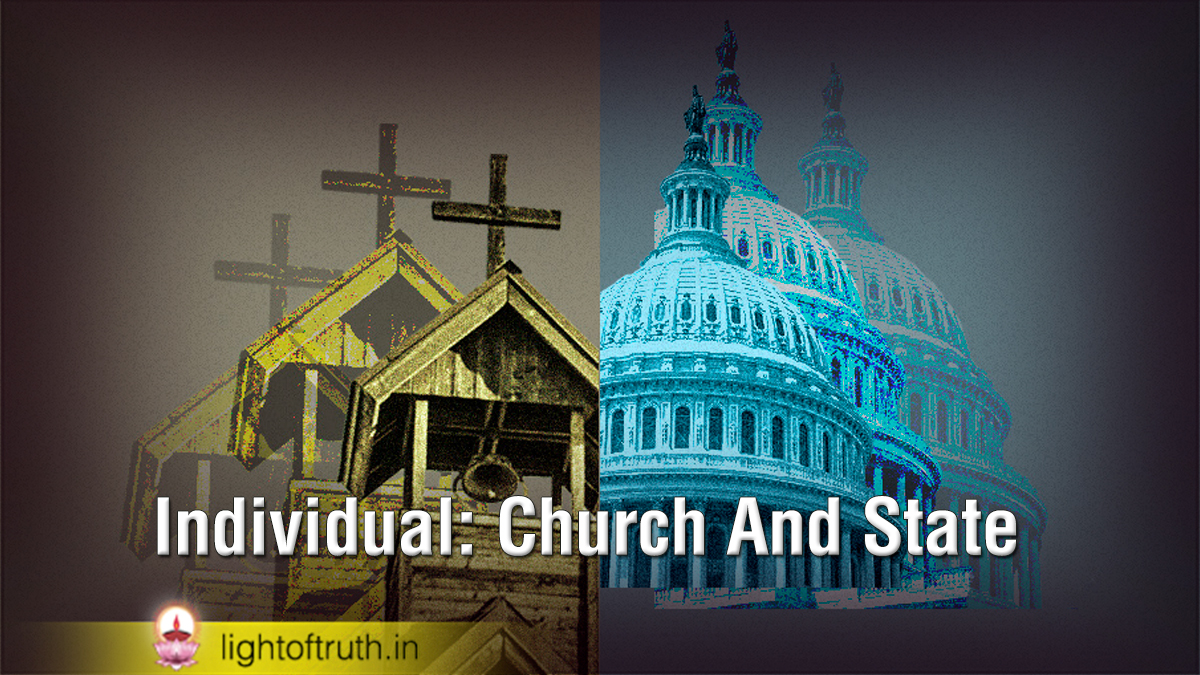
 The perennial riddle facing humanity is: how can the needs of the individual and the claims of the collective be harmonized? Or, how can the empowerment of the individual be pursued as contributive to, and not subversive of, the cohesion of the collective -whether the collective be the State, the society, the Church, or even the family?
Often, the claims of these two entities are assumed to be incompatible. Votaries of unbridled individualism feel the claims of the System as unjust and oppressive. The votaries of the System, in turn, regard the posturing of individualists as irrational and subversive; for which the terms in vogue today are ‘urban Naxals’ and anti-national ‘tukde, tukde gangs’.
Primitive societies practised rites of initiation into adulthood. These rites were characterized by symbols of death and rebirth. Through them the individual ‘died’ to his family and was ‘reborn’ -or, born again, in Christian terminology- as one with, and for, the tribe. Borrowing St Paul’s words, a person initiated thus could jolly well say, ‘It is no longer I who live, but it is my tribe that lives within me’.
When, in due course, the totalitarian State arrived, it began to view all competing loyalties as dangerous. The identity of the individual was required to be totally subsumed in the State. The State was the de facto Father to all subjects, who were entitled to rights and protections only as subordinate to the interests of the State. This resulted, even to a greater degree than it did in the tribal context, in the absorption of the individual into a collectivity. The State, as Dostoevsky said, would provide bread; but the subjects would have to pay for it with their freedom. They could not have both at the same time. The individual exists for the State; the more absolute the State, the more absolutely so.
It is against this background that Jesus’s idea of the Church and its unique role need to be understood.
The heart of Jesus’s vision is embedded in the exhortation: ‘Be perfect’. The scope of the individual ‘perfection’ to be sought must be understood in relation to the dignity and worth that Jesus attached to the soul. Viewing the pursuit of perfection from a general or specialist perspective, the world deems it an extravagant and unrealistic goal. Now, the world too believes in the supreme worth of the individual. But limits the scope of that realization to an individual; or, at best, to a clutch of individuals around the Supremo.
So, if Modi would not tolerate another to stand even with him, he is being also faithful to the logic of the State. The personality of all is perceived as inimical to the personal ultimacy that he is obliged to assume even as a concession to State Absolutism. There is no point in invoking his chai-wala background as Mani Shankar Iyer did. The point is that today Modi is not the old chai-wala, but the Prime Minister of a confessedly hard state. Under monarchy, this was assumed to be the hallmark of the King. ‘The King is dead. Long live the King’.
In light of the above, let us ask: Why is it implied in the New Testament that the ‘nations of the world’ are under the sovereign control of Satan? This needs to be addressed as a matter of historical realism, and not as a religious prejudice. Can we have even a cursory glance at history hitherto and discount Satan’s claim that the nations of the world belong to him? Are the rulers of the world inspired by the Holy Spirit or possessed by the Father of lies?
All the same, there is biting irony in all this. If the price for absolutizing the State is the authenticity of individuals, the perversity of it cannot but catch up with the State itself. And it does. The State becomes an agglomeration of the lowest instincts of the nonentities comprising the masses. It is for this reason that we do not expect any ethical sensitivity or humanistic ideal from the State. As a matter of fact, the idea of ‘fundamental rights’ implies a recognition of the harm that the State can inflict on individuals, against which they need to be protected by law.
So, from a Christian point of view, two extremes have to be avoided. First, extreme, disruptive, anarchic individualism: the individual existing for himself, no matter what. Second, the Absolute State that reduces individuals to a faceless collectivity. Both forms disrupt the sense of community, which is a profound psychological need for humankind.
What, then, is the alternative? The alternative is the Church, provided it is true to itself. The quintessence of the Church understood as such is the perfection of the individual. The foremost priority of the Church should, therefore, be to facilitate the pilgrimage to perfection that every member has to undertake. It is this that Jesus, in the course of his conversation with Nicodemus, denoted as being ‘born again’.
In the tribal context, the individual is born again as part of the tribal herd. In the civilizational context -the context of the modern State- the individual is reborn as a citizen whose ultimate loyalty is to the political tribe, the nation. In the spiritual context, the individual is ‘born again’ as part of the family of God, or the Kingdom of God.
Traditionally the Church has chosen to understand itself as the local and universal manifestation of the Kingdom of God; an understanding that complements the assumption that the Church is the Bride of Jesus, or the Body of Christ. To be part of the church is to be incorporated into the Body. This ought to safeguard individual believers from the extremes to which, otherwise, he or she remains historically and psychologically vulnerable: that of becoming a part either of the tribal or of a political herd at peril of being reduced to a cog in the machine, or a cheering mouth in the mass.
The Church that nourishes believers now, and in the days ahead, will be one that understands this unique role that no other worldly system can, or would, play. It is futile for the church to try and be a second-class State; thereby making the primary secondary, and vice versa. What is the use in surviving as such, if the price to be paid is the loss of authenticity, the spiritual saltiness of the Church; the very essence of her relevance to the world?