Spiritual Contours Of The Sacrament – Part 5
- Valson Thampu
Jesus said: (to the expert in Jewish law) “Go and do likewise” (Lk.15:37)
True religion¸ or religion practised holistically, has two parts: knowing and doing. In the formal context, though, a chasm opens up, and gradually widens, between the two. Knowing becomes a merit in itself. As a result, a discontinuity comes about between knowing and doing, between belief and behaviour. This breeds hypocrisy which, to Jesus, seemed ineradicable in religion as religion. ‘Foolishness’ from the point of view of true religion, or spirituality, is that ‘hearing’ is not completed with ‘doing’ (Mt.7:24ff)
The fundamental issue in the human plight is not dearth of knowledge. It is the discontinuity between knowing and doing. The Sacrament was Jesus’s way of addressing this universal religious malady.
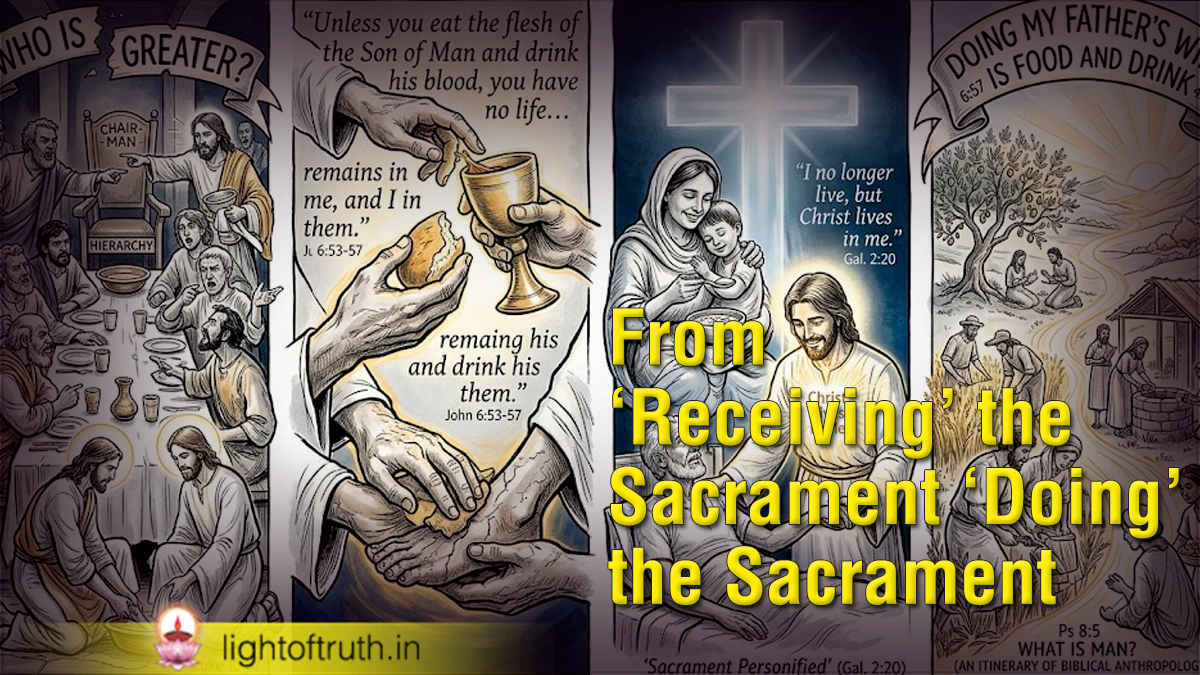
Arguably, this is the key issue that Jesus addresses through the Last Meal. In its run up, behind and beyond the sacramental music of brokenness we can hear the murder, “Who is greater?” “Who is greater?” (Lk. 22:24) That this dispute should erupt among the disciples immediately after being exhorted by Jesus that the hallmark of their membership in the Kingdom of God is humility!
What, then, is the sacramental solution to the perennial problem in humankind’s religious life? Fortunately, Jesus has answered this question for us-
Jesus said, “Very truly I tell you, unless you eat the flesh of the Son of Man and drink his blood, you have no life in you. Whoever eats my flesh and drinks my blood has eternal life, and I will raise them up at the last day. For my flesh is real food and my blood is real drink. Whoever eats my flesh and drinks my blood remains in me, and I in them. Just as the living Father sent me and I live because of the Father, so the one who feeds on me will live because of me. (St. John 6:53-57)
In simple and direct words, the solution lies in being one with Jesus. Jesus is the truth (Jn.14:6). ‘In him there is no darkness at all’. He is all light. He is the ‘yes-yes’ that life utters to itself. The sacramental essence of our ‘abiding in him, and his abiding in us’ rules out hypocrisy altogether. It makes the resultant state of life one of pure light. …. ‘You are the light of the world’ (Mt.5:14).
In the passage from St John 6: 53-57, Jesus expresses the significance of the Sacrament. If it is indeed the body of Jesus and his blood that we eat and drink, we will attain a state of perfect oneness with him. This is the same as saying that those who dwell in Jesus are in the sacramental state. They have become Jesus himself. They will think and act like him. And others will see Jesus in them. We need, therefore, to be reminded from time to time of the new creation that we have become through Jesus. “This you do in remembrance of me,” is not a sentimental request, but a profound spiritual discipline: ‘the one thing needed’ so to speak. Our quintessential calling is not to be religious in a formulaic manner, but to incarnate Jesus. Those who abide in Jesus have to be Sacrament personified. Nothing less, nothing more.
Is this an ideal impossible to be realized? Well, St Paul did not think so. So, he said, — I have been crucified with Christ and I no longer live, but Christ lives in me (Gal. 2:20). Peter too, likewise. How else would he say to the man begging at Gate Beautiful: ‘In the name of Jesus of Nazareth, rise and walk”? (Acts 3:6) The nucleus of the Sacramental is Jesus’s oneness with God. It is by virtue of this sacramental logic that Jesus says, ‘He who has seen me has seen my Father’.
The hallmark of this blessed state is true humility. This is flagged in the background of the Last Supper with the obsession as to who will occupy the seats to the left and right of Jesus, when he comes in glory (Mk.10:25ff). This characteristic religious dirt that Jesus tries to wash away via the feet-washing he performs. It is not their feet, but their nature, that Jesus seeks to cleanse. In his own characteristic, creative manner he urges them to realize that they are not to be religious ‘chair-men’, but the living replicas of the Son of Man who didn’t even mind if he had anywhere ‘to lay his head’. The sacramental is profoundly and uncompromisingly anti-hierarchical. Where love reigns, what hierarchy?
‘Doing’ is in the nature of love. True love, the love that never fails, is dynamic and creative. It does; and never tires of doing. Its truest statement is, ‘Doing my Father’s will is food and drink for me’. Jesus went about doing good; and never became weary of it.