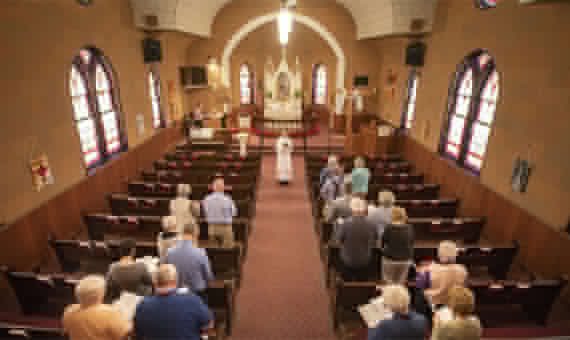
For 100 years, Lutherans in this farming community on the Minnesota prairie have come to one church to share life’s milestones.
They have been baptized, confirmed and married at La Salle Lutheran. Their grand parents, parents and siblings lie in the church cemetery next door. But the old friends who gathered here early one recent Sunday never imagined that they would one day be marking the death of their own church.
About the series this is the first in an occasional series about Christianity at a crossroads — a time of unprecedented decline in church membership and a changing future for the faith.
“Sunday used to be set aside for church: that’s what families did,” said Donna Schultz, 74, a church member since grade school at La Salle, in southwest Minnesota. “Now our children have moved away. The grandkids have volleyball, dance on weekends. People are busy with other things.
“I’m really going to miss this,” she added quietly, gesturing to her friends in the lobby. “We’re like family.”
The rising toll is evident in rural, urban and suburban churches across the state.
St Paul’s On the Hill Episcopal Church on prestigious Summit Avenue was recently sold to a developer after more than a century of religious service. Bethany Lutheran Church in the Longfellow neighborhood of Minnea-polis held its “holy closure” ceremony last fall. St Michael Catholic Church in West St Paul celebrated its last mass 18 months ago.
Mainline Protestant churches have been hit the hardest. The Evangelical Lutheran Church in America (ELCA) in Minnesota has lost almost 200,000 members since 2000 and about 150 churches. A third of the remaining 1,050 churches have fewer than 50 members. The United Methodist Church, the second largest Protestant denomination in Minnesota, has shuttered 65 churches since 2000.
Catholic membership statewide has held steady, but the number of churches fell from 720 in 2000 to 639 last year, according to official Catholic directories. The Archdiocese of St Paul and Minneapolis, which closed 21 churches in 2010 and merged several dozen others, is again looking at ways to consolidate church staffing and programs.
The closings and mergers are leaving a void in communities where churches frequently house child care, senior programs, food shelves, tutoring and other services.
And it seems likely to get worse. Most Americans still report that they are Christian, but the worshipers in the pews on Sunday increasingly have gray or white hair. The median age is older than 50 for nearly all mainline Protestant denominations, according to the Pew Research Center, a national polling and research group in Washington, D.C. For Catholics, it’s age 49.