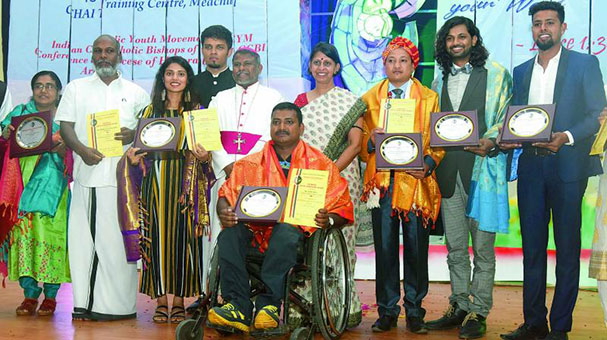
The second national youth conference, 2019, hosted by the archdiocese of Hyderabad, organised by the Indian Catholic Youth Movement (ICYM) at the Catholic Health Association of India (CHAI) concluded. With over 450 people, from 70 dioceses, showcasing 14 regional cultures from all over India, the five-day conference which commenced on October 13th, was an exceptional journey for youth in attendance.
Category: From The States
-
Church should redeem flock, not chase miracles
The Vatican’s strategy to make up for shrinking numbers of the faithful in the traditional catchments of Europe and the West has energized the Catholic Church in India.
However, the process of canonization, mandating two miracles, has nevertheless led to a controversy over the archaic practice, centered on medical as well as theological grounds.
On October 13, Pope Francis conferred sainthood on Thrissur-born Mother Mariam Thresia, the founder of the Congregation of the Holy Family.
This prompted the Kerala chapter of the Indian Medical Association (IMA) to seek an explanation from Doctor V.K. Sreenivasan, a neonatologist at the Amala Institute of Medical Sciences in Thrissur, for reportedly “certifying the miraculous cure of a newborn afflicted with a seemingly incurable primary pulmonary hypertension.”
The child reportedly recovered dramatically after its parents prayed to Mother Thresia from the hospital bed in 2009.
“Dr Sreenivasan, who travelled to the Vatican as a witness, has to tell us what specific markers he had found in the child’s condition to claim supernatural healing. We come across many instances of a cure, often very rare and medically the least anticipated. But to call them miracles is outside the pale of medical ethics,” says Doctor N Sulphie, the IMA state general secretary.
The criticism from within the Church against miracles is centered on the legacy of saints, hailed as iconic examples rather than miracle workers or intercessors. The fullness of heroic lives of virtues, as witnessed by fellow humans, should be sufficient for their veneration as role models. Miracles are merely the interpretation, attributing divinity to causes mortals espouse.
Says Fr Paul Thelakat, the chief editor of “Sathyadeepam” (Light of Truth): “I do know that the Church has strict procedures with respect to miracles and relics, but I may suggest a real rethinking from the theological and scientific point of view two items in canonization, namely the necessity of two miracles and relics. It is time to have a cultural, theological and pastoral re-evaluation of the meaning and the relevance of relics in our times.”
India, home to Christianity for centuries, has survived the paradox of being without a saint for nearly 2,000 years. The first Indian saint was Gonzalo Garcia, a martyr, canonized in 1862. Out of a total of six saints in the country, five were canonized after 2000.
-
Amid tension, India’s Naga Christians fast for peace
Amid fears of the collapse of 22-year-long peace talks between Naga tribal insurgent groups and the Indian government, hundreds are praying for peace in Christian-majority Nagaland State. Several Naga militant groups fighting for a separate tribal homeland joined on the Oct. 23 fast to pray for the success of the ongoing peace talks.
-
Catholic Church in India vows to fight for rights of minority Christians
Circumstances are difficult for the Christians in our diocese—we often come up against restrictions in the practice of our faith,” said Bishop Stephen Antony Pillai.
The 67-year-old prelate heads the Diocese of Tuticorin in southern India. He and 53 other Indian bishops recently met with Pope Francis during an ad limina visit to Rome. Bishop Pillai spoke about the situation of Christians in India.
The bishop explained that the Indian government is working to transform the primarily Hindu country into a homogenous nations, with one language and one set of policies favoring Hinduism. Comprised of 29 federal states, India is, after China, the second most populous country in the world with 1.37 billion inhabitants.
There are 28 million Christians in India, 20 million of whom are Catholic; the Muslim population numbers more than 200 million. In recent years, both Christians and Muslims have increasingly been targeted with violence and harassment by radical Hindu nationalists.
The situation has worsen-ed after this year’s parliamentary elections, which the nationalist governing party BJP of Prime Minister Narendra Modi won with a significant majority.
“Our situation at the moment isn’t very encouraging. The government makes a lot of rash decisions, which makes things unpredictable. Politics only benefits the wealthy part of the population. The poor are left with nothing,” Bishop Pillai said.
Some 450,000 Catholics live in the Diocese of Tuticorin, which is equivalent to about 17 percent of the population. Besides the attacks targeting the faithful and groups of pilgrims, the bishop reported that the circumstances overall were becoming more difficult in his diocese, with authorities interfering with the administration of Catholic hospitals and schools.
-

Prime minister, political, religious leaders mourn Abp Jala’s death
Prime Minister Narendra Modi led political and religious leaders to mourn the death of Archbishop Dominic Jala of Shillong in a car accident in California. The Salesian arch-bishop “will be remembered for his impeccable service to society and passion towards Meghalaya’s progress. May his soul rest in peace,” tweeted the prime minister on October 12, soon after the news of the Catholic prelate broke.
The Prime minister also said that he was anguished by the passing of the archbishop.
The accident reportedly occurred around 11 pm October 10 (10:30 am on October 11 Indian time) when Archbishop Jala was traveling to Clearlake in California along with Fathers Mathew Vellankal and Joseph Parekkatt, two Indian priests working in the United States.
-
Minister Muraleedharan leads Indian delegation to Mariam Thresia canonization
Minister of State for External Affairs V Muraleedharan led the Indian delegation at the ceremony in which Pope Francis will declare Mariam Thresia a saint in Vatican City on Oct. 13. Muraleedharan visited the Vatican City on October 12-13 for the canonisation of Sister Mariam Thresia, the Ministry of External Affairs said.
Sister Mariam Thresia, born on April 26, 1876, in Thrissur, Kerala, founded the Congregation of the Sisters of the Holy Family in 1914. She passed away on June 8, 1926. On April 9, 2000, she was beatified by Pope John Paul II.
In his ‘Mann ki Baat’ radio program last month, Prime Minister Narendra Modi had also referred to Sister Thresia.
“Sister Thresia, in her short lifespan of 50 years, worked for the good of humanity becoming a noble example for the entire world. Whatever task Sister Mariam Thresia undertook and accomplished, she did so with utmost dedication and devotion,” he had said.
-
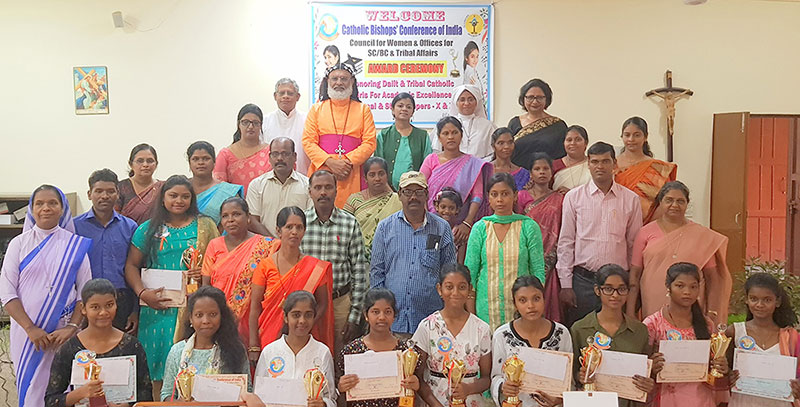
Dalit, tribal girls honoured for academic excellence
Ten tribal and dalit girls from various parts of India were honoured for their academic excellence at a recent function in the national capital.
The awards have been hailed as a novel and unique move by the Catholic Church in India to reach out and encourage the less fortunate girl children, Sister Talisha Nadukudiyil, national secretary for the Council for Women under the Catholic Bishops’ Conference of India (CBCI), said at the October 6 award ceremony.
According to the Sisters of Destitute nun, the move will bring to the limelight those blessed with intellectual acuity to reach the high spectrum of life.The selection of the awardees was made on the basis of their outstanding performance in studies, despite their financial, cultural and geographical hedges, the nun explained. This is the second year the award program was organized by the women council in collaboration with the CBCI Offices for Dalit and Tribal Affairs.
-
India’s Christian philosophers to discuss science’s perils, possibilities
The 44th annual research seminar of the Association of Christian Philosophers of India (ACPI) will take place at the St Joseph Vaz Spiritual Renewal Centre, Old Goa. The October 23 to 25 addresses the theme: “Philosophizing Science: Promises, Perils and Possibilities.”
The seminar will be co-hosted by the Indian Institute of Science and Religion (IISR), Delhi.
Goa and Daman Archbishop Filipe Neri Antonio Sebastião do RosárioFerrão is the chief guest and inaugurate the seminar. Jesuit Father Job Kozhamthadam, director of IISR, will deliver the keynote address.
The theme “Philosophizing Science” has to do with the philosophical critique of science from diverse yet wholesome Indian and Christian perspectives, according to Jesuit Father Keith D’Souza, president ACPI.
The subtheme “Promises, Perils and Possibilities” lends itself to discussions on positive, dysfunctional and futuristic aspects of various features and disciplines of the scientific enterprise.
-
Jesuits in India promote pope’s ecological agenda
There are still areas in which the Jesuits can work to protect the environment in India, according to a member of the order.
On February 19, Father Arturo Sosa, the superior general of the Society of Jesus, urged his men to give a pastoral priority to ecological issues, as a direct response to Pope Francis’s 2015 encyclical Laudato Si’.
Jesuit Father Luke Rodrigues said it was also a response “to the crisis we experience today in terms of environmental degradation.”
The Jesuits of the Bombay Province – based in Mumbai – took up this call, building on already existing programs to protect the environment.
“In the rural areas, there are many ecological initiatives in the field of agriculture. Farmers working in dry regions – such as Nashik district – are encouraged to take up water harvesting schemes,” the priest said.
“This works on the principle of catching the water where it falls, thereby replenishing the groundwater table. This assures farmers of at least one good crop and at times the possibility of a second one too. Fruit plantations are now coming up, thanks to the enhanced supply of water,” he said.
Nashik is located about 120 miles north of Mumbai and has a large agricultural sector, most famous for its vineyards.
-
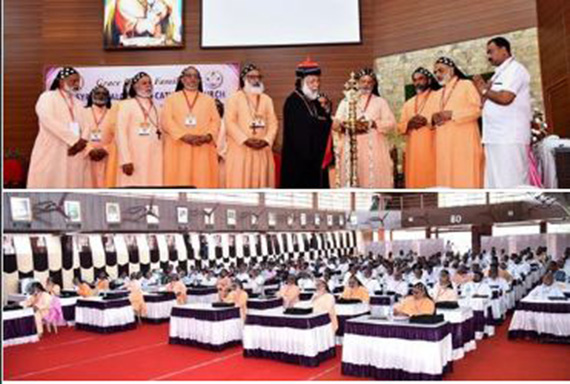
Major Archiepiscopal Assembly begins
Major Archbishop of the Syro-Malankara Church Cardinal Mar Cleemis has highlighted the relevance of family values for the betterment of society. Delivering the inaugural address at the second Major Archi-episcopal Assembly of the church here on Oct. 8, he said, family values and religious belief were increasingly coming under attack. If the family lost belief in God, it would reflect on religion and society, he added.