Abp. Peter Machado of Bangalore on January 21 urged Catholics in his archdiocese to observe a day of reparation after miscreants desecrated sacred Hosts in a church. “I am not only terribly shocked and greatly grieved that desecration was done to the Eucharistic Lord in that church,” the archbishop said in a press note.
Category: From The States
-
Salesians educate 300 poor children in Rajasthan villages
The Don Bosco Development Society is providing education in 10 villages in the State of Rajasthan, for 300 extremely poor and disadvantaged children, including children of farmers and workers in quarries. The educational project is supported by the van Ameringen Foundation, which provides funds for innovative and practical programs for early intervention. Don Bosco Development Society provides hope and support for those who have few resources and little hope for the future. Father Rolvin D’Mello, executive director of Don Bosco Development Society, has expressed great enthusiasm for the project, which is helping children grow and study.
-
Kerala Church welcomes state check on religious education
A church official in the southern Indian State of Kerala has welcomed a direction from the state’s High Court for privately run schools not to impart religious education without government permission. The court ruled on whether schools unaided by the state can promote a particular religion to the exclusion of other religions in elementary schools.
“It is a welcome order and the government needs to know what kind of religious education is being imparted in a private school,” said Father Varghese Vallikkatt, deputy secretary-general of the regional body of Catholic bishops in Kerala.
The court had considered a petition from Hidaya Educational and Charitable Trust, a Muslim body that runs several schools in the state. It challenged the state shutting down one of its schools on grounds that it promoted exclusive religious instruction and admitted only Muslim students, violating India’s secular principles.
-

India’s Eastern rite Church seeks clarification on controversial law
Bishops of India’s eastern rite Syro-Malabar Church have urged the federal government to clarify amendments made to the country’s citizenship law on Jan. 11, a day after the new law came into force. The prelates’ call came during their ongoing Bishops’ Synod, the Church’s top decision-making gathering, at their headquarters in Kochi city in southern Kerala State.
Of the 64 bishops, 57 are attending the Jan. 7-15 Synod.
India’s federal government led by the pro-Hindu Bharatiya Janata Party amended the Citizenship Act of 1955 on Dec. 11, 2019.
The Citizenship Amendment Act (CAA) aims to grant citizenship to illegal migrants from Afghanistan, Bangladesh, and Pakistan if they are not Muslims. The new law also relaxes the requirement of residence in India from 11 years to five years for such migrants.
Since the amendment, the country has witnessed wide-spread violent protests seeking to scrap it on the grounds that it violates the secular fabric of the country as it was biased against Muslims.
“The secular character of our constitution shall not be under any doubt,” he said, explaining the reason for bishops seeking clarification. The bishop also urged the government to grant citizenship to refugees in the country with-out any religious discrimination.
-
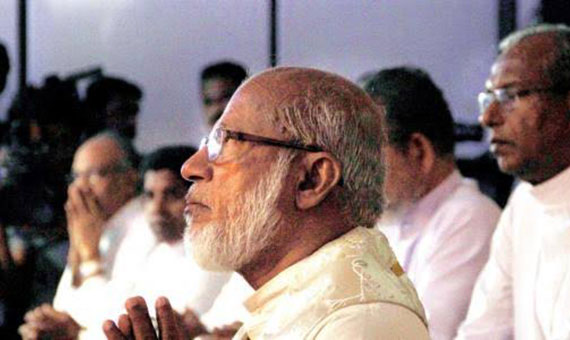
Bishops ask Alencherry to clarify stand to laity
Kochi, Jan 14, 2020: The issue of land deals has come up for discussion during the Synod session of the Syro-Malabar Church now under-way at the Church headquarters in Kochi.
Nine bishops of the Ernakulam-Angamaly Archdiocese raised the issue on January 13 when a suggestion came up that the Synod could admit to the losses incurred because of the land deals.
Cardinal George Alencherry, head of the Church who is entangled the land deal controversy, informed the members that the losses could not be recovered without selling the land.
The bishops wanted a clear declaration of the ways of restitution, instead of admission of lapses. To this, the cardinal said he had not made any monetary gains out of these deals. The bishops, however, suggested that the cardinal could explain his stand in the matter before the priests and laity and convince them.
The Synod is yet to release an official statement regarding the discussions and decisions taken in the meeting.
“There came some suggestions from the Synod regarding the ways in which the losses can be rectified but no official statement has been released by the Synod. Earlier, the Synod had accepted that severe lapses occurred from the cardinal’s part,” said a source in the Ernakulam-Angamaly Archdiocese.
A source said the coming days of the Synod meeting are crucial. “As Synod concludes on Wednesday (January 15), some major decisions will be taken,” he said. The Synod began on January 7.
-
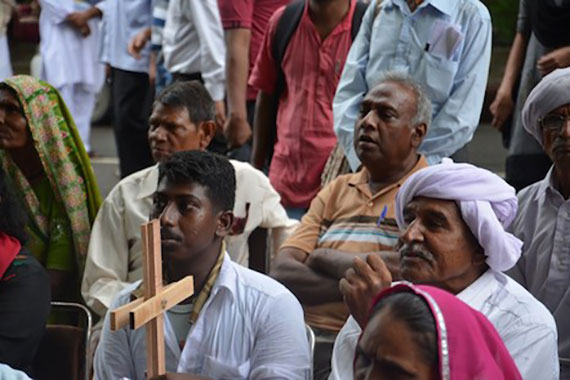
Indian court agrees to review Dalit Christian plea
India’s Supreme Court has agreed to examine a petition calling for Dalit Christians to be afforded the same social benefits given to Dalit people from other religions and has informed the federal government about the matter.
The court was hearing a plea filed by the National Council of Dalit Christians (NCDC) seeking Scheduled Caste status for Dalit Christians.Scheduled Caste is the official name given to lower castes that are now protected by the Indian government and offered special concessions such as civil service jobs and places in schools.
Christians are currently denied government benefits meant for the social welfare of poor people based on the argument that Christianity does follow the caste system.
The Supreme Court’s decision to review the petition was welcomed by Christian groups.
“It is a huge success for all of us as we have been longing for this day for decades. We all know that justice delayed is justice denied,” Father Vijay Kumar Nayak, secretary of the Indian Catholic bishops’ office for Dalits and lower classes told UCA News.
“Different governments have come and gone, all gave assurances but nothing happened but at least now the Supreme Court has agreed to listen to us and we welcome it wholeheartedly,” he said.
“Whatever the outcome of this step, the future of the Dalit Christians looks brighter and we are hopeful that something good comes of this,” Father Nayak said.
A bench comprising Chief Justice S.A. Bobde and justices B.R. Gavai and Surya Kant issued notice to the Ministry of Social Justice and Empowerment, National Commission for Scheduled Castes, National Commission for Minorities and Registrar General of India that it will be reviewing the petition.
-
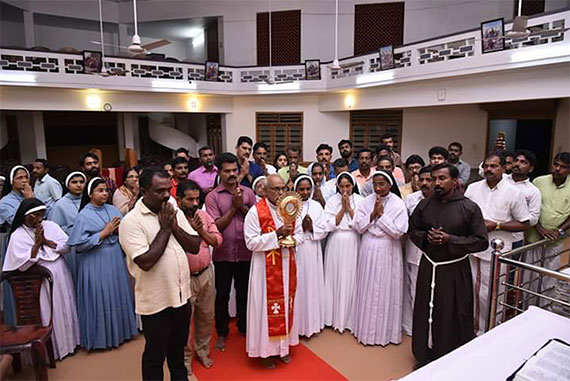
“Miracle” Host sent to Rome for scientific study
A Catholic parish in Kerala has sent its “miracle” Host to Rome for further studies as part of a process to declare it as a Eucharistic miracle. A face resembling that of Jesus had appeared on the host during Mass on November 15, 2013, at the Christ the King Church, Vilakkannur, a parish under the Syro-Malabar Archdiocese of Tellicherry.
Baby Joseph Payikatt, a former trustee of the parish, said the host was taken to the Syro-Malabar Church’s headquarters at Kakkanad, a suburb of Kochi, on January 10 and handed it over to Apostolic Nuncio Archbishop Giambattista Diquattro the next day.
The nuncio had come to St Thomas Mount in Kakkanad to attend the Syro-Malabar Church’s January 7-15 Synod.
The host has been venerated as a miracle at the Vilakkannur parish since September 21, 2018, when the archdiocese returned it after five years. Earlier, it was kept at the arch-bishop’s residence. Fr Vengakunnel with the relic “A four-member team led by our parish priest Father Mathew Vengakunnel carried the host to Kochi,” Payikatt told Matters India on January 13.
-

Xavier Ratna for Jesuit Felix Raj
Jesuit Father Felix Raj, vice chancellor of St Xavier’s University, Kolkata, was honoured with Xavier Ratna Award by the Xavier Institute of Engineering, Mumbai on January 11 at its 11th Convocation. Father Raj was the Chief-Guest for the Convocation and delivered the Convocation Address. Jesuit Father John Rose, the Director of the Institute gave away the award on behalf of the institute and the Jesuit Province of Mumbai.
-
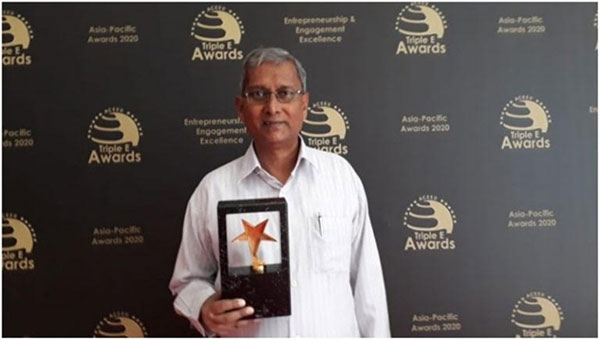
Salesian varsity receives ‘Engaged University of the Year 2020 Award”
Assam Don Bosco University won the “Engaged University of the Year 2020 Asia Pacific (Entrepreneurship and Engagement Excellence) Award” on January 10. This prestigious international award was conferred by the Accreditation Council for Entrepreneurial & Engaged Universities (ACEEU), Netherlands.
-
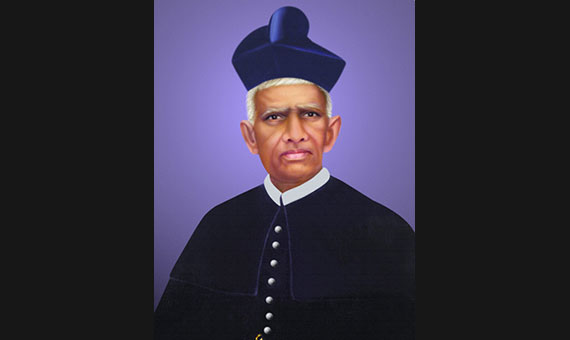
Founder of Kerala’s Vincentian congregation on sainthood path
Father Varkey Kattarath, the founder of Vincentian Congregation, will be declared a Servant of God soon, marking the commencement of the cause for his canonization. The priest was born on October 31, 1851, and died on October 24, 1931. His mortal remains were interred at St Gregorious Church, Thottakam.