Category Archives: Asian

Pope prays for victims of typhoon in Asia

Towards the end of the Mass for the Jubilee of Catechists, and before reciting the noonday Angelus prayer on 28 September, Pope Leo addressed the faithful gathered in St Peter’s Square. His thoughts turned in particular to Asia, where, he said, “a very powerful typhoon” has struck several regions, “in particular the Philippines, the island of Taiwan, the city of Hong Kong, the Guangdong region and Vietnam”

“I assure the affected populations,” the Pope continued, “especially the poorest, of my closeness and my prayers for the victims, the missing, the many displaced families, the countless people who have suffered hardship, as well as the rescue workers and civil authorities.” “I invite everyone to put their trust in God and to show solidarity with others. May the Lord give strength and courage to overcome every adversity.” Typhoon Ragasa, which said to be the strongest so far this year, has forced the evacuation of over two million people in Guangdong alone. In addition to extensive damage, flooding, power outages and landslides, it has caused at least 25 deaths in the Philippines and 14 in Taiwan.

Asian Bishops gather to deepen synodality ahead of 2026 FABC Plenary in Bali

The FABC Bishops Seminar on Synodality, held at Baan Phuwan, opened with Mass on September 23 presided over by Archbishop Anthony Weradet Chaiseri, vice president of the Catholic Bishops’ Conference of Thailand, ahead of the 2026 Federation of Asian Bishops’ Conferences (FABC) Plenary Assembly in Bali. “The purpose was to study and understand the Final Document of the Synod together, reflect on our dioceses, and consider how the Church in Asia can put it into practice,” Archbishop Chaiseri told LiCAS News. The prelate also noted that the gathering revisited the Bangkok Document, issued during the FABC’s 50th anniversary in 2022, which is deeply connected to the global synodal process.

Participants used a process modeled after the Synod of Bishops in Rome—combining lectures, prayerful reflection, and small-group sharing. 

Nine group discussions focused on three themes: the link between the Synod’s Final Document and the FABC’s Bangkok Document of 2022; the reception of the synodal pathway across Asia; and the need for transparency and accountability in a synodal Church.

Archbishop Chaiseri noted that Asia’s contemplative approach to discernment—marked by silence, listening, and consensus—aligns closely with the global synodal method of Conversation in the Spirit.  The seminar comes as the global Church enters the implementation phase of the Synod, following the release of the Final Document in November 2024 and a framework introduced by Cardinal Mario Grech in March 2025.

Running until 2028, the process calls for bishops to set clear goals and timelines while ensuring broad participation across all sectors of the Church. This includes not only clergy and parishioners but also young people, marginalized communities, and those sceptical of the synodal process. Catholic schools, hospitals, prisons, and digital platforms are also expected to play a role, alongside religious communities and lay movements.

“These meetings reflect the growing desire among Churches in Asia to deepen synodality, strengthen communion, embrace the path of synodality within the Church, and walk in closer unity with the Universal Church under the guidance of Pope Leo XIV,” Archbishop Chaiseri said.

Latin Patriarchate of Jerusalem forgives school debt of all diocesan families

The Latin Patriarchate of Jerusalem has decided to forgive the school debts of all families in the diocese for the school years prior to the Jubilee of Hope as a gesture “to promote and demand justice, equity, and, above all, solidarity.” The patriarchate is the Latin-rite Catholic diocese based in Jerusalem, reestablished in 1847 by Pope Pius IX. Its ecclesiastical jurisdiction encompasses Israel, Palestine, Jordan, and Cyprus, serving the Latin Catholic communities present in the Holy Land and these regions of the Middle East.

In a statement, Cardinal Pierbattista Pizzaballa, Latin patriarch of Jerusalem, said the jubilee year “has taken place in a context of violence and war,” which “seems to be increasing evermore.” The cardinal explained that under the motto “Hope Does Not Disappoint,” Catholics are called “to a special conversion of heart. We are called to return to God, to rediscover our Christian roots and the beauty of our faith.” They are also called to “heal the relationships we have wounded” and to “rediscover the joy of encountering Christ.”

Despite the perilous situation in the region, one that has had “serious consequences for the lives of all our families and institutions,” Pizzaballa said he sees it as an opportunity not to get lost “in petty and short-sighted considerations but to focus on the essentials of life in our relationship with God and in the life of the world.”

Thus in order to give expression to “this desire for change, for renewal, for a return to God and to our brothers and sisters,” the patriarchate has decided to forgive “all debts of all the families to the schools of the Latin Patriarchate for the years prior to the jubilee, that is, up to and excluding the 2024-2025 school year.”

“This was not an easy decision to make because of the costs involved. As you can imagine, the various administrative offices did not fail to raise their legitimate concerns. Nevertheless, we feel it is necessary to make this gesture and to once again trust and rely on God and his providence,” the patriarch wrote. “We hope that this gesture will make life easier for many of our families in need and help them to regain confidence and hope,” the statement added.

Chinese government bans Catholic priests from teaching, evangelizing online

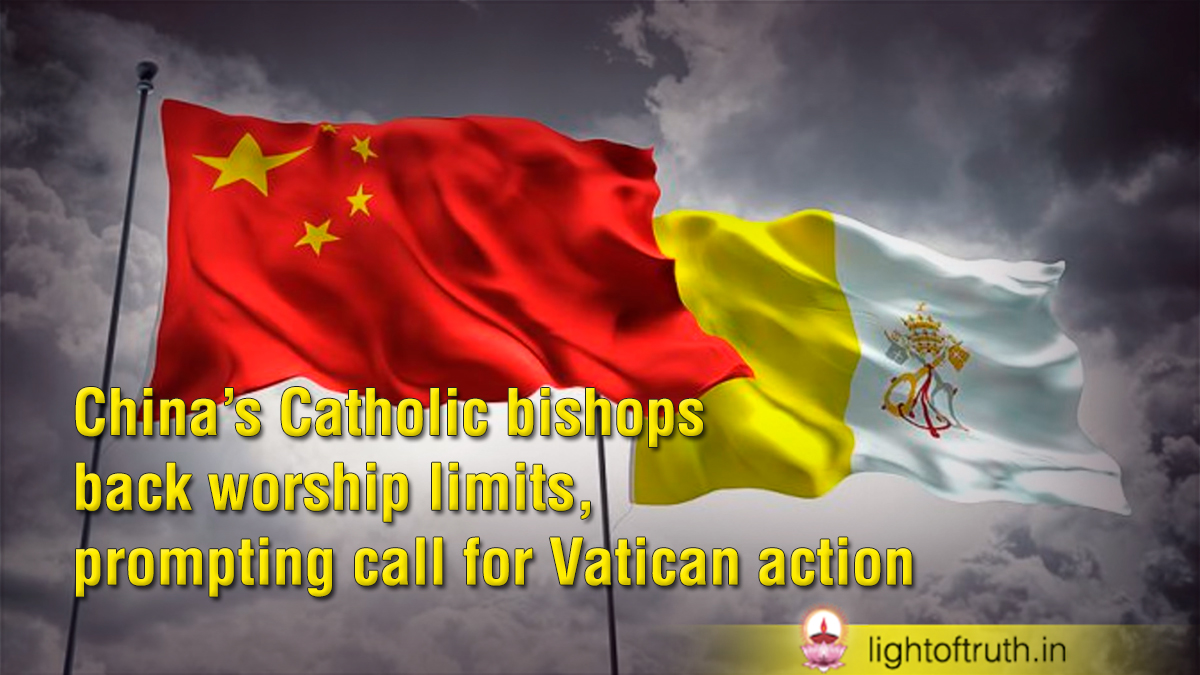
New regulations from the State Administration for Religious Affairs in China have enacted a ban on several major forms of online evangelization for religious clergy of all religions, including Catholic priests. The new Code of Conduct for Religious Clergy on the Internet comprises 18 articles. Among stipulations that religious clergy must “love the motherland” and support Chinese leadership of the Communist Party of China and its socialist system, faith leaders are banned from preaching and performing other religious rituals through live broadcasts, short videos, or online meetings. 

Priests may only do so on “websites, applications, forums, etc. legally established by religious groups, religious schools, temples, monasteries, and churches” with approval from the Chinese government. Furthermore, whenever using social media accounts or messaging apps to send out information, religious clergy must provide “certificate of membership as registered religious clergy” to their internet service providers. Clergy are banned under the code from both the evangelization and education of minors on the internet, and from organizing educational opportunities, such as seasonal camps for minors on the internet. They are also banned from making money online and from raising money to build religious places or for holding religious activities. 

“If a religious clergy violates this standard, the religious affairs department shall order them to make corrections within a time limit,” the code of conduct states, adding: “If they refuse to make corrections, the religious affairs department shall … punish them in accordance with the provisions of relevant laws and administrative regulations.” For “serious” offenders, the code recommends religious institutions suspend their teaching activities or revoke their religious status. “Religious teachers and officials who carry out online activities through overseas websites and platforms shall abide by this standard,” the code states.

Catholic father murdered while on pilgrimage to Marian shrine in Pakistan

Men on motorcycles murdered a father and injured a 16-year-old boy while they were taking part in a pilgrimage to the national Marian shrine of the Virgin Mary in Mariamabad in Pakistan, an incident that has shocked Christians in the Muslim-majority country. According to the Vatican news agency Fides on Sept. 12, Afzal Masih, a married father of four, was murdered on Sept. 7 while he was on a pilgrimage to the shrine located in the Archdiocese of Lahore.

“We are deeply saddened by the murder of Afzal Masih. He was a devout Catholic who was participating in a Marian pilgrimage to venerate and pray to the Virgin Mary. Today, we express our deepest condolences to his family,” Father Tariq George, rector of the shrine, told Fides. The murder occurred while Afzal Masih was traveling with 15 other members of the faithful and several young men on motorcycles approached the minibus and began to provoke the group.  When the pilgrims stopped at a gas station 19 miles from the shrine, a man identified as Muhammad Waqas opened fire with a rifle, killing Afzal Masih with a shot to the neck and wounding his 16-year-old cousin, Harris Masih, in the arm. Afzal Masih was taken to the hospital but died. After his arrest, Waqas told police that he “had no intention of killing.” Christians in Pakistan are calling for an investigation into the case and for justice to be done.

Pakistani police probe ‘murder’ of three Christians

Police in Pakistan’s national capital, Islamabad, have launched an investigation after finding the bodies of three people — a Christian man, his teenage son, and daughter — inside their locked home under mysterious circumstances. The bodies of 42-year-old Akram Paul, his 18-year-old son Shabbir, and 15-year-old daughter Neha were discovered on Sept. 10 inside their residence in Rimsha Colony, according to police inspector Muhammad Aslam of the city’s Sabzi Mandi Police Station. “We are examining all possibilities, including murder and accidental death. No detail is being overlooked,” the officer told UCA News. Police found the bodies after neighbours alerted them, he said.

Quoting police sources, Pakistan daily The Nation reported that the victims had been deceased for approximately two weeks. Their hands were tied, and there were multiple wounds on their bodies. The victims were possibly assaulted with sharp weapons. The door of their house was locked from the outside, and Akram’s motorbike, which was parked outside, was stolen, the news report said.

Pastor Samuel Masih, who leads Paul’s New Life Church in the area, told UCA News that Paul converted to Christianity from Islam “many years ago.” He had been “an active member of the church since his conversion.” Paul reportedly became a Christian but married a Muslim woman after his first wife died. The two children were from his previous marriage.

Pastor Masih and other Christians in the Rimsha Colony, an enclave of some 1,000 Christian families, suspect the murder was a targeted attack motivated by religious hatred. “This is not an ordinary crime. Our brothers and sisters in Christ are living under constant threats. We demand protection and justice,” Masih said. Paul’s Christian neighbour, speaking on condition of anonymity, remarked, “Our children are afraid to leave their homes. The community feels vulnerable and unsafe.” Pastor Masih said the murder of Paul’s family “is a tragedy for the entire Christian community in Islamabad. We demand swift action and protection for our people.”

China: Giuseppe Ma Yan’en installed as Auxiliary Bishop of Zhangjiakou

The structure of the new Diocese of Zhangjiakou, established by Pope Leo XIV on July 8 by merging the territories of the Dioceses of Xiwanzi and Xuanhua, is taking further shape. On September 12, the Holy See Press Office reported that, “within the framework of dialogue concerning the application of the Provisional Agreement between the Holy See and the People’s Republic of China,” the “civil recognition and assumption of office” of Giuseppe Ma Yan’en as Auxiliary Bishop of Zhangjiakou took place.

The 65-year-old prelate, already Bishop of Xiwanzi and now assisting Bishop Joseph Wang Zhengu, consecrated as the first Bishop of Zhangjiakou, was born in 1960 in Baoding. He was ordained a priest in 1985 for the Apostolic Prefecture of Yixian, where he served as Vicar General. He received episcopal ordination in January 2010 and in 2013 became Bishop of Xiwanzi, a circumscription of which he took canonical possession on March 28 of that year.

“It is received with satisfaction,” said Matteo Bruni, Director of the Holy See Press Office, “that today, on the occasion of the assumption of office as Auxiliary Bishop of Zhangjiakou by Joseph Ma Yan’en, his episcopal ministry has also been recognised within the framework of civil law.” At the same time, the statement added, “the episcopal dignity of Monsignor Augustine Cui Tai, Bishop Emeritus of Xuanhua, has also been civilly recognised.” “These events, the fruit of dialogue between the Holy See and the Chinese authorities,” Bruni concluded, “represent a significant step in the journey of communion of the new Diocese.”

Bangladesh Catholics plant 1 million trees inspired by Laudato Si’

In Bangladesh, the call for “care for nature” in Pope Francis’s encyclical Laudato Si’ has resonated deeply across religious lines. Christians, Protestants, and non-Christians alike have embraced its message, sparking environmental action in a country increasingly vulnerable to climate change. Bangladesh, a coastal South Asian nation, faces frequent natural disasters — floods, cyclones, river erosion, and landslides — that claim lives and displace communities. Ranked as the ninth highest disaster-risk country globally, it sees hundreds of villagers migrating to cities each year due to river erosion and climate-induced hardship.

In response, the Catholic Bishops’ Conference of Bangladesh (CBCB) launched an ambitious initiative to plant one million trees nationwide. The program began on August 14, 2020, during the COVID-19 pandemic, with all bishops present at the CBCB Centre in Dhaka.

“Planting trees remains one of the most powerful actions we can take to combat climate change, which is why our bishops prioritize it,” Father Tushar James Gomes, assistant secretary general of the Catholic Bishops’ Conference of Bangladesh, told Catholic News Agency. “Laudato Si’ has significantly raised awareness about the importance of caring for our environment,” he added. “People now understand that protecting nature is not optional — it’s essential.”

Tushar emphasized that the Church is moving beyond tree planting. “We are working to declare parishes and organizations as ‘green and clean.’ Many church-run organizations are phasing out plastic bottles and single-use items. Though not yet 100% successful, the effort continues.” The Episcopal Commission for Justice and Peace has played a leading role in translating, promoting, and publishing Laudato Si’ in Bengali. Holy Cross Father Liton H. Gomes, secretary of the commission, told Catholic News Agency that public awareness about environmental care has grown significantly.

Interfaith workshops continue to strengthen the movement. On June 27-28, 2025, a training on life and nature protection was held at the CBCB Center in Dhaka, attended by 90 participants, including Catholics and Protestants, organized by the Episcopal Commission for Justice and Peace and World Vision Bangladesh. From tree planting to interfaith dialogue, Bangladesh’s Christian community is living out the spirit of Laudato Si’, proving that care for creation transcends religious boundaries — making it a shared human responsibility.

Masonic Controversy in the Philippines: Augustinian Priest Suspended After Blessing Ceremony

The delicate relationship between Catholicism and Freemasonry resurfaced in the Philippines this month when a local priest was suspended after blessing a Masonic marker in a public ceremony. The incident, captured in photographs and quickly circulated on social media, has ignited debate over ecclesial discipline, doctrinal clarity, and the lived realities of Catholic life in a country where Freemasonry has a visible social presence. On September 1, the Discalced Augustinians (OAD) announced the temporary suspension of Father Libby Daños, a priest serving in Ormoc City in Leyte province. The measure followed viral images showing Daños blessing a stone marker inscribed with Masonic symbols — a gesture that, according to Church authorities, contradicts Catholic teaching.

Father Luigi Kerschbamer, provincial prior of the OAD, said the priest had not fully realized the implications of the event but nevertheless acknowledged that the action caused scandal among the faithful. In a formal statement, Kerschbamer emphasized that Daños expressed “deep regret” and is cooperating with a canonical investigation. While the case is under review, Daños is barred from exercising public ministry. “The incident illustrates the need for vigilance,” Kerschbamer wrote, adding that the order is strengthening formation programs for its members to ensure they can discern situations that may compromise the Church’s witness. The suspension comes at a time when the Vatican has repeatedly clarified its stance on the incompatibility between Catholic faith and Masonic affiliation. In November 2023, the Dicastery for the Doctrine of the Faith reiterated that Freemasonry, particularly in the Philippines, is not limited to formal lodge members but includes a wide circle of sympathizers who consider their involvement compatible with Catholic identity. The statement firmly rejected that view, warning Catholics against participation in Masonic activities.

Holy See announces progress in bilateral relations with Viet Nam

The XII meeting of the Viet Nam – Holy See Joint Working Group took place in Vatican City on 12 September 2025. The Meeting was co-chaired by H.E. Madam Le Thi Thu Hang, Deputy Minister of Foreign Affairs, Head of the Vietnamese delegation, and Monsignor Mirosław Wachowski, Under-Secretary for Relations with States, Head of the Holy See delegation.

The two sides held an extensive exchange of views on the Viet Nam – Holy See relations and the current situation of the Catholic Church in Viet Nam. Both sides acknowledged the positive contributions of the Church to the overall development of Viet Nam, in the spirit of living out the Gospel in the world by being good Catholics and good citizens.

Both sides expressed satisfaction with the progress in their bilateral relations since the XI Meeting of the Viet Nam – Holy See Joint Working Group, which took place in Ha Noi in May 2024, including through regular engagement and consultations, exchanges of delegations at various levels, especially at the high level, as well as the activities of the Resident Papal Representative in Ha Noi, H.E. Archbishop Marek Zalewski.

The two sides underlined the importance of further promoting their bilateral relations through high-level exchanges, and agreed to continue holding regular Meetings of the Joint Working Group.

The Meeting took place in an atmosphere of friendship, trust and mutual respect. On the occasion of the visit to the Vatican, the Vietnamese delegation was received by His Holiness Pope Leo XIV, and paid courtesy calls to the Secretary of State, Cardinal Pietro Parolin, and to the Secretary for Relations with States and International Organizations, Archbishop Paul Gallagher.