

The Holy See Press Office has released the official logos and mottos for the Pope’s upcoming visit to Asia. The Pope’s journey to the continent – which will include stops in Indonesia, Papua New Guinea, Timor Leste, and Singapore – is scheduled to take place on September 2-13, 2024.
Pope Francis will land in Jakarta, Indone-sia, on September 3, remaining until the 6th.
The logo for this visit features the Pope with his hand raised in blessing, standing in front of a golden “Garuda”, a sacred eagle, which has been depicted in a manner reminiscent of traditional Indonesian “batik” fabric. Inlaid is a map of Indonesia, an archipelago characterized by a great variety of ethnic and social groups, languages, cultures and religious beliefs. The Apostolic Journey has been given the motto ‘Faith – Fraternity – Compassion’.
Next, the Pope will travel to Papua New Guinea, where he will remain until Sept. 9.
The centrepiece of the logo for this visit is a cross, depicted in colours meant to evoke Papua New Guinea’s sunrises and sunsets. On the cross, a Bird of Paradise, symbolising Papua New Guinea, can be seen. The motto for this Apostolic Journey is “Pray”, inspired by the disciples’ request to Jesus: “Lord, teach us to pray” (Lk 11:1).
From Papua New Guinea, Pope Francis will travel to Timor Leste, remaining until September 11. In the centre of the logo for this journey, we see Pope Francis with his hand raised in blessing. Behind him is the globe, from which a map of Timor Leste emerges. Above, written in an arc, is the motto of the papal visit, “May your faith be your culture”, an exhortation to the Timorese people to live out their faith according to their culture and traditions.
The Pope’s final stop will be the island nation of Singapore, which he will visit on September 11-13. The logo for this Apostolic Journey depicts a stylized cross, inspired by the star that guided the Magi, by the Eucharist and by the five stars of the flag of Singapore. On either side of the Cross is the motto of the Apostolic Journey: “Unity–Hope.”
Category Archives: Asian
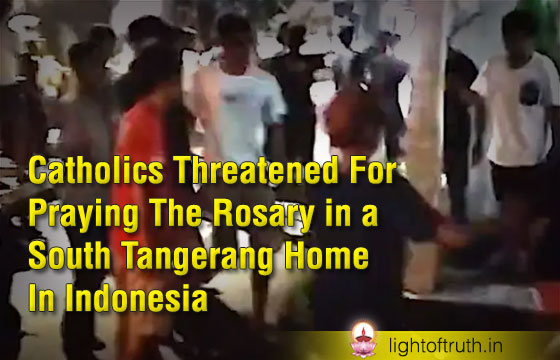
Catholics Threatened For Praying The Rosary In A South Tangerang Home In Indonesia
Catholic students from Pamulang University (UNPAM) were threatened by Muslim extre-mists as they prepared to pray the rosary. A group of armed Mus-lim men broke into the home of a Catholic family in South Tange-rang[I] that was hosting students. Shouting threats, the attackers ordered the university students to stop the prayer activity and dis-perse as soon as possible.
It seems that the hostilities were fomented by a man called Diding. “If you perform any praying, do it in your church as we local Muslims are used to do it in our mosque; not in a resi-dential house like this,” Mr Di-ding said, according to witnesses. “A dozen UNPAM students were reciting the rosary at the home of a local Catholic,” said a political activist known as Mr A. “We were at the police’s command post until at 3 am to demand perpe-trators be held accountable for last night’s hostile deed,” Mr A told. Speaking to local media, Chief Superintendent Alvino Cahyadi said police were looking into the case after a video about the incident was posted on social media. Some female students suffered minor injuries.
A similar incident took place in 2014, when Julianus Felicianus, a Catholic, opened his home to the community near Yogyakarta to pray the rosary, an activity that many Christians engage in, in the month of May. A group of Mus-lims targeted the Catholic gather-ing and Felicianus received threats, including death threats, from several people.

Card Chow In Guangdong: New Bridge With Catholics In Mainland China
Exactly one year after his historic visit to Beijing in April 2023 (almost 30 years after the last one), a delegation of the Diocese of Hong Kong led by Card Stephen Chow Sau-yan made a new, important visit to Catholic communities in mainland China.
From 22 to 26 April, the Chinese cardinal – together with Auxiliary Bishop Joseph Ha Chi-shing, Vicar General Fr Peter Choy Wai-man, and a small group of priests and lay people involved in pastoral care – travelled to Guangdong province where they held meetings in the dioceses of Guangzhou and Shantou as well as the Church of Shenzhen.
This is a very significant aspect of the task of building bridges, the cardinal laid out in his ministry for the Church of Hong Kong. Guangzhou and Shenzhen are large metropolises in southern China. With Hong Kong, they constitute the huge metropolitan area of the Pearl River Delta, which are increas-ingly becoming a single commu-nity through large-scale infra-structural development under-taken by Beijing.
For Card Chow, this was his first visit to these dioceses and on his return he relayed his impre-ssions to the diocesan weekly Sunday Examiner. He said, for example, that he was struck by the large number of parishes that a priest has to serve in China, citing as an example two parish priests who serve 31 parishes in Shantou.

Climate Change And Work: When It’s The Heat That Kills In The Factory
South Asia and Southeast Asia have been facing an exceptional heat wave, which in several countries has caused the mercury to rise above 40 degrees Celsius, with peaks of up to 45.
From Bangladesh to Thailand, passing through vast regions of India, Myanmar, Cambodia and the Philippines, there have been casualties due to the high temperatures. Governments have run for cover by decreeing the closure of schools. But there is also another aspect on which it becomes particularly significant to dwell on this day of 1 May: the effect that increasingly prohibitive weather conditions have on the world of work.
It was precisely to the incidence of this problem in the countries now affected by the exceptional heat wave that the Global Labour Institute, the research institute of the American University of Cornell that analyses working conditions in the supply chains of global markets, devoted an interesting study a few months ago. Entitled ’A Higher Level? The Climate Crisis, the World of Fashion and its Effects on Workers’, the survey deals with the impact of two phenomena such as rising temperatures and increasingly frequent flooding on the lives of workers in the textile and footwear industries in Bangladesh, Cambodia, Pakistan and Vietnam, four countries that alone account for 18% of world production in these sectors.
They come to an extremely alarming conclusion: without adequate mitigation measures, not only will the health of local workers become more and more at risk every day, but also the very productivity of the companies is destined to collapse, with the real risk of a ‘cut and run’ approach that would entail very high social costs.

Benoit Thun, The Missionary Who Brought The Cistercians To Vietnam To Be Raised To The Honours Of The Altars
The closing session of the diocesan phase of the process of beatification of Fr Benoît Thun (1880-1933) came to an end today in the Lateran Palace. This is a “moment of celebration for the whole Church” in Rome as well as in Vietnam, said Bishop Baldassare Reina, the vicegerent of the Diocese of Rome.
Born Henri François Denis, the French missionary arrived in Vietnam in 1903 where he founded in 1918 the monastery of Our Lady of Annam in PhýÛc Sõn, Archdiocese of Hu¿, the country’s first male monastic community.
As required by canon law, the documentation concerning the holiness of this servant of God still highly venerated in Vietnam were sealed and handed over to the Dicastery for the Causes of Saints, in a ceremony attended by Dom Mauro Giuseppe Lepori, Abbot General of the Cistercian Order, and Dom John XXIII, Abbot President of the Cistercian Congregation of the Holy Family, the branch founded in Vietnam by Fr Benoît Thun.
A native of Boulogne-sur-Mere (France), Fr Henri François Denis was ordained a priest for the Mission Étrangères de Paris on 7 March 1903. He left for Vietnam a few months later, assigned to the mission in Hu¿, where he took the name Thun, which in Vietnamese means obedience.
He adapted to the local culture, interacting with people to serve them, without any air of superiority. Eventually, as he pursued his missionary apostolate, he felt strongly called to bear witness to the Gospel with a monastic style.
Sipri: Never Before Has Arms Expenditure Been So High In Asia
In 2023, the greatest growth of the last decade was recorded in terms of global military spending, which reached its historic high for a total sum of 2.4 trillion dollars driven by Asia-Pacific tensions (Taiwan ) and the conflict between Israel and Hamas (as well as Iran).
This is the data from the latest report published on April 22 by Sipri (Stockholm International Peace Research Institute), from which another interesting fact also emerges: the greatest increases at a geographical level concerned Asia, the Middle East and partly the Europe due to the war between Russia and Ukraine which has been dragging on for over two years.
“Total military spending is at an all-time high” senior researcher Sipri Nan Tian underlines to AFP, according to which “we have witnessed an increase in spending in all five geographical regions.”
In numerical terms, the in-crease in military spending is 6.8% and represents “the most significant on an annual basis since 2009” as the expert adds. “[This increase] is a reflection of the deterioration – he adds – of peace and security in the world,” also because “there is no region in which the situation has improved.” At country level, among the top five for military spending in the annual Sipri report are: United States, China, Russia, India and Saudi Arabia.
Japanese Woman Is Baptized After Witnessing How Her Catholic Husband Lived With Faith His Cancer
Junko Kusanagi is a Japanese woman who for 49 years lived without having a significant experience that would lead her to have a deep faith. However, the illness of her husband, who is Catholic, led her to consider faith more than ever as a necessary element in her life. Junko says she attended a Catholic school and university, but never took much interest in the faith. When she was about to marry her current husband, he revealed to her that he was Catholic, and she mentions that perhaps if she had not had a previous experience with Catholicism, she would likely have reacted more hostilely to this statement. However, her previous contact with Catholicism allowed her to not have such a repulsive reaction to her husband’s faith.
Sometime later, when they had their son, Junko’s husband expressed his desire to have him baptized as a Catholic, to which she was at first a bit hesitant to do so. She decided to consult with her husband’s sister who told her that she had always felt God’s presence in her life because she had been baptized as a child, and this motivated Junko to accept the baptism of her son. The baptism took place and Junko remembers her husband telling her that he was very happy because even if something happened to them, their son would be in good hands because God would be with him. Junko mentions that her life went smoothly until October 2022 when her husband told her that he had just been diagnosed with cancer. At that time, she became so worried about the future of her husband and family that she went into shock.
In contrast, her husband was very composed, which impressed her. She asked him how he could be so calm, to which he replied, “I’m fine. God is always here”.
From that moment on she discovered something she had never seen in the person of her husband, a faith that she had interpreted simply as something that made her husband a “calm and ordinary” person, but at that moment she realized that his faith was so great even to be fearless, even though the future was uncertain. This began to make her rethink her position on faith. Upon realizing this situation and together with the desire to walk alongside her husband in this difficulty, she decided that she wanted to be baptized. She discussed this with her husband who was glad that he had become ill because it brought her to a deepening of the faith, he had always believed in.
Thus, Junko began her journey to the Church and among other things she is grateful to the parish community are the accompaniment and the availability to be with her and accompany her in this difficult time. Since they had moved house, she had no friends with whom she could talk or feel accompanied, but in the church community there is always someone to listen to her. Junko was baptized at the Easter Vigil at the Sekimac church.
Colombo, Still No Justice On The Fifth Anniversary Of The Easter Attacks
On the occasion of the fifth anniversary of the Easter attacks, the Catholic Church of Sri Lanka has organized various religious celebrations and is preparing to name martyrs the faithful killed in the attacks which targeted three churches and two hotels. According to the most recent investigation into the tragedy, over 300 people, including 40 foreigners and 45 children, lost their lives on 21 April 2019, the worst massacre to occur in Sri Lanka since the civil war.
Lahore, Forced Conversions: Attempted Poisoning Of A 13-year-old Christian
Yet another attempt at forced conversion has occurred in Pa-kistan against a 13-year-old Chri-stian boy, forced to ingest a toxic substance after refusing to em-brace Islam.
The episode occurred in the city of Lahore on April 13: Saim had left home to go get a haircut, but was stopped by a Muslim se-curity guard who noticed that the boy had a cross around his neck. The guard, named Qadar Khan, snatched the necklace and forced Saim to recite an Islamic prayer, but the boy refused, saying he was Christian. The man then forced Saim to ingest a toxic substance in an attempt to poison him.
It was the young man’s parents who found their son’s body unconscious after several hours that Saim was missing from home. The father, Liyaqat Randhava, went to the police but said he had received unfair treatment.
The officers registered the complaint only after several in-sistences and a copy of the docu-ment was not released to Saim’s family, he said. Furthermore, se-veral parts of the story were not included in the complaint.
(also called first information report or FIR).
Joseph Johnson, president of Voice for Justice, expressed deep concern about the growing incidents of forced religious conversions in Pakistan and condemned what happened to Saim, adding that the police were showing extreme negligence in the case. “By failing to include crucial details in the FIR, the police subjected Saim and his family to further abuse,” Johnson said, calling for government intervention in an investigation.
Asian Bishops’ Climate Change Desk Holds Ecology Conference
More than 30 church workers from various bishops’ conferences in Asia on April 15 ended a three-day workshop on building climate-resilient communities.
The workshop, organized by the Office of Human Development – Climate Change Desk (OHD-CCD) of the Federation of Asian Bishops’ Conferences (FABC), was hosted by Caritas Philippines in Tagaytay City, the Philippines. Participants engaged in thorough discussions on prevailing climate trends and the sustainability issues facing the region. They also shared best practices and action plans in battling the impacts of the climate crisis.
Bishop Allwyn D’Silva of Bombay, chairperson of the OHD-CCD, said the Catholic Church must get “more involved” in various environmental concerns because “Asia is a home to many of the countries that are vulner-able to climate change.” The prelate challenged churches in Asia to “build up a network” of advocates and “like-minded act-ors” to spearhead climate actions, all dedicated to fostering climate-resilient communities.
During the workshop, Dr. Benedict Alo D’Rozario, president of Caritas Asia, discussed how the Catholic Church’s social action and humanitarian arms are trying to collectively defend and empower communities against the impacts of the ecological crisis.