One of the most touching deeds that made Pope Francis go down in history was his 2017 visit to Bangladesh, which included a meeting in Dhaka with a group of Rohingya refugees who had fled violence in Myanmar.
Silent tears and heartfelt words that marked the embrace moved the world and became a symbol of his deep commitment to justice and compassion. On that occasion, Francis prayed with the Rohingya.
Since then, he has often reminded the world of their suffering. More than a million Rohingya live in Bangladesh, forcibly displaced from Myanmar where they are persecuted.
“Even though we are few and often forgotten – dispersed, marginalised, and afflicted – we grieve with the global Church,” said Peter Saiful, a representative of the small Rohingya Catholic community, also displaced in Bangladesh, speaking to AsiaNews.
“Pope Francis was a beacon of hope for the marginalised, a voice for the voiceless, and a man whose humility touched hearts across all boundaries,” Saiful explained. “As members of a persecuted and displaced people, we saw in Pope Francis the living compassion and solidarity of Christ. That encounter during his visit is a deeply moving and unforgettable moment in our community’s history.”
Pope Francis liked to say: “You cannot be a Christian without living like a Christian, and you cannot be a Christian without practising the Beatitudes. And one of the Beatitudes is to welcome the stranger.” Rohingya Christians are grateful to God for the pope’s life and ministry, dedicated to justice, peace and the unity of God’s people.
Category Archives: Asian
Vietnam and Francis: the seed of dialogue that has already borne fruit
Long queues of faithful are openly and freely honouring Pope Francis in cathedrals. An official paid homage to the late pontiff on behalf of the government by burning incense in front of the pope’s portrait at the headquarters of the Catholic Bishops’ Conference of Vietnam (CBCV). While analysts are trying to read some hidden meaning in the two lines of condolence published in China by the Chinese Catholic Patriotic Association, the pope’s death showed where the seed of dialogue is already bearing much fruit, namely in China’s neighbour Vietnam, which offers a model for the delicate path relations between the Holy See and China could take.
The news of Francis’s death reached Vietnam on April 21 just as the country’s Catholic bishops were gathered for the spring session of their assembly. Quickly, a delegation led by the CBCV president, Archbishop Giuse (Joseph) NguyÅn Nãng of Ho Chi Minh City, left for Rome to take part in the pontiff’s funeral while the websites of the dioceses were filled with news about Pope Francis, stories from Rome, and the condolences from Vietnamese Catholics.
China largely silent on Pope Francis’ death amid global tributes
High-ranking heads of state and Catholic bishops in China have remained notably silent following the death of Pope Francis, while reactions from political and religious leaders across the globe poured out on social media within hours of the pope’s passing on Monday morning.
AsiaNews reported on April 22 that Chinese officials are not permitted to express themselves publicly on Pope Francis’ death due the Chinese Communist Party (CCP)’s control over the Church there. The Chinese government offered a brief statement nearly 24 hours after the Holy Father’s passing, only after reporters asked foreign ministry spokesperson Guo Jiakun about it on April 22.
“China expresses its condo-lences for the death of Pope Francis,” he said, adding that “in recent years, China and the Vati-can have maintained constructive contacts and engaged in useful exchanges. China is ready to work with the Vatican to promote the continuous improvement of China-Vatican relations.”
Notably, the CCP posted a tribute to Pope Benedict XVI after his passing two years ago, stating: “We entrust Benedict XVI to God’s mercy and ask him to grant him eternal rest in heaven.” Several days have passed since Pope Francis’ death with no similar statement from the CCP.
“I mean, it’s really astonishing because they have an agreement with the Vatican,” Hudson Institute Fellow Nina Shea told CNA on Wednesday. ”It’s a refle-ction of their refusal to acknow-ledge the supremacy of the papal authority over the Catholic Church and that they see the pope only in secular terms as a head of state, the Holy See.”
The Vatican-China agreement to allow Chinese-appointed bishops in the Catholic Church was renewed last year and is set to remain intact until October 2028, despite numerous reports of Chinese violations of the deal and continued persecution against Catholic bishops.
“The absence of condolen-ces,” Shea said, “is a sign that they do not see the pope as the religious head of the Catholic Church and they do not want their people to associate the pope, the papacy, with the Catholic Church in China.”
Philippines makes history as first nation to consecrate itself to divine mercy
The Philippines made history this year on April 27, Divine Mercy Sunday, by becoming the first nation in the world to consecrate itself entirely to Jesus through divine mercy.
In 2016 at the Pan-African Congress on Divine Mercy Sunday in Rwanda, bishops in Africa consecrated the continent itself to divine mercy. However, the Philippines is the first singular nation to do so.
“This is remarkable; this is really unprecedented. Never has this been done before in the history of the world – a country consecrating themselves to the divine mercy,” said Father James Cervantes of the Marians of the Immaculate Conception (MIC), a congregation devoted to spreading the message of divine mercy. “I believe the bishops are being inspired by the Holy Spirit to lead our country to holiness.”
The bold initiative began with a single spark – a heartfelt letter from Cervantes to bishops across the country calling for a nationwide consecration to divine mercy. Dioceses responded enthusiastically, and soon the idea spread like wildfire.
The Permanent Council of the Catholic Bishops’ Conference of the Philippines (CBCP) gave its official approval, declaring that a national consecration to divine mercy will take place during all Masses on April 27 as part of the 2025 Jubilee Year celebrations.
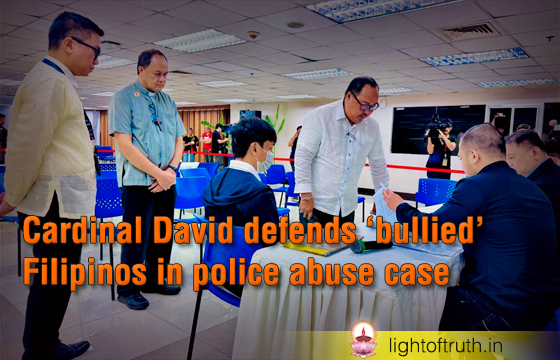
Cardinal Pablo Virgilio David, president of the CBCP, issued a statement calling on all dioceses, parishes, religious communities, and Catholic institutions to participate in this landmark spiritual initiative.
Cardinal Bo: ‘Pope Francis had profound respect for people of Asia’
“Pope Francis related to all, with the broken, the forgotten, and the earth itself. He made room in his heart for those the world pushed aside. And so now, as the world mourns him, we feel the sorrow that always follows great love.”
In a wide-ranging interview with Vatican News, Cardinal Charles Maung Bo, Archbishop of Yangon and President of Myanmar’s Bishops’ Conference, who served two terms as the President of the Federation of Asian Bishops’ Conferences, remembered the late Pope Francis in this way following his return to the Lord on 21 April.
Cardinal Bo had the joy of being named by Pope Francis as the first-ever Cardinal of Myanmar, and of welcoming the Holy Father to his nation in November 2017.
Remembering Pope Francis’ historic Apostolic Journey to his nation, the Cardinal said, “Despite significant pressure from various quarters urging him not to visit our country, and despite the many challenges that loomed large, Pope Francis chose to come. And in doing so, he shone a great light upon the suffering of our people.”
In fact, the Cardinal remembers, “Pope Francis had a profound affection for the people of Asia,” adding, “he fell in love with the people of Myanmar.”
Over the years, the Pope has made constant appeals for Myanmar, for peace and for aid, and even before his passing, not only did he express his condolences for all those affected by the tragic quake, but he also offered sustenance to help the suffering population.
As of April 19, 2025, the death toll from the 7.7-magnitude earthquake that struck Myanmar on March 28 stood at 3,726, with 5,105 injured and 129 still missing. The disaster has compounded Myanmar’s existing humanitarian crisis, with nearly 20 million people in need of aid due to ongoing civil conflict.
Bangladesh allows Catholic de-addiction work among prisoners
The Bangladesh government has allowed a Catholic-run de-addiction centre to use its training programs and therapy to help inmates addicted to drugs in the country’s largest prison. Holy Cross Brother Francis Nirmal Gomes, director of the Church-run Bangladesh Rehabilitation and Assistance Centre for Addicts, said the government permission came on April 7, making it an “important day” for the organization. The permission allows the centre to work in Dhaka Central Jail in Keraniganj, a suburb of Dhaka, the capital of the Muslim-majority nation. According to media reports, the facility has about 4,500 inmates, including several hundred drug addicts. Gomes said in a social media post that the permission from the Ministry of Home Affairs came “after many years of efforts.” The ministry also oversees the Department of Narcotics Control. He thanked the government and said it is an opportunity for the organization to offer professional support to drug-addicted prisoners. Gomes also thanked his Holy Cross Congregation for supporting him with financial assistance. His centre is among the first professional treatment and rehabilitation organizations for drug addicts in the country. Late American Holy Cross Brother Ronald Drahozal founded it in 1988. The centre has successfully rehabilitated more than 5,000 drug-addicted individuals. It also runs four centres for street children vulnerable to crimes and drug addiction. Over the years, the centre has won various awards.
Philippines: Church calls for discernment ahead of elections
Nearly 70 million Filipinos will head to the polls on 12 May, 2025, to vote in midterm elections, electing lawmakers and representatives for local governments with over 18,000 candidates vying for legislative, local, and regional posts. As the Philippines head for critical midterm elections in May, the Church in the country warns against hate speech and fake news. Ahead of the election the Philippine Bishops’ Conference (CBCP) has issued a Pastoral Letter urging voters to use their voices to uphold freedom and ensure the common good. In the letter entitled “Be Concerned for the well-being of others” the bishops reminded voters that the “primary responsibility of a public servant” is to improve the lives of the Filipino people “especially the poor and the vulnerable.” We need competent leaders and legislators with sincere intentions who serve the good of our parishes, cities, provinces, and the entire country,” the bishops said. The May elections will also contest 317 congressional seats and thousands of local posts.
Christians in Iraqi Kurdistan gather for ecumenical Palm Sunday procession
The Christian faithful of Ankawa, a suburb of Erbil in Kurdistan Region, Iraq, came together on Saturday, 12 April, to witness their faith and ecumenical unity during the annual Palm Sunday Procession. Organized by the Catechetical Committee of the Chaldean Catholic Archdiocese of Erbil, the event was organized under the theme: “Hosanna in the highest, blessed is He who comes in the name of the Lord.” The event drew hundreds of participants in a celebration rooted in shared faith and common witness, bringing together leaders and faithful from various Christian denominations in a shared act of worship and unity, culminating in prayer at the Shrine of Mar Elia.
The procession commenced at the Patriarchal Cathedral of St. John the Baptist of the Assyrian Church of the East and proceeded toward the historic Shrine of Mar Elia, a sacred site for the Chaldean Catholic faithful. Leading the event were high-ranking Church leaders, including His Holiness Mar Awa III, Patriarch of the Assyrian Church of the East, Abp Bashar Warda, Chaldean Catholic Archbishop of Erbil, Abp Nicodemus Daoud Sharaf of the Syriac Orthodox Church, and Archbishop Natha-nael Nizar Agam of the Syriac Catholic Church. They were join-ed by priests, deacons, catechists, and representatives from the Kurdistan Regional Government, all united in prayer and song.
The procession was marked by the active participation of children enrolled in catechetical programs, many of whom led the faithful in hymns and carried palm and olive branches—symbols of peace, hope, and the triumphant entry of Christ into Jerusalem. Syriac Orthodox Scouts and Syriac Catholic catechism students accompanied the march with chants and spiritual songs.
Upon arrival at the Shrine of Mar Elia, the faithful gathered for a concluding prayer service, offering gratitude for the gift of Christian fellowship and the enduring presence of Christ in their midst. The procession, now in its 14th consecutive year, has become a cornerstone event in the life of the Christian community in Ankawa—an annual moment of renewal, identity, and interchurch collaboration.
Airstrikes destroy another Catholic church in Myanmar
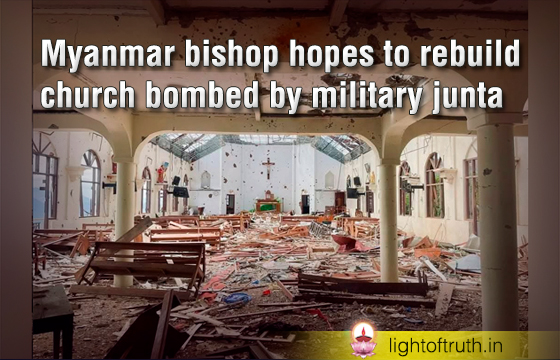
As fighting between the military junta and resistance forces continues despite the recent earthquake, the regular army bombs the Church of Christ the King in the town of Falam, Chin State. Airstrikes by the regular army have destroyed another Catholic church in Chin, Myanmar’s only Christian-majority state, marking yet another tragic chapter in country’s ongoing civil war between the military junta and resistance forces that continues to severely impact Christians and their places of worship.
The Church of Christ the King in the town of Falam, part of the Diocese of Hakha, was hit on April 8. According to Fides local sources the church’s roof and interior have been devastated, but the building’s walls are still standing. The church had only been recently built with great sacrifice to meet the needs of the local Catholic community of around one thousand faithful. It had been consecrated and opened for worship in November 2023, replacing a small chapel that had existed for 75 years. “There is great sadness now in the community, but also the desire and determination to rebuild,” the source told Fides.
Southeast Asia: Traffickers pose as Christian missionaries, pilgrims to exploit victims
Investigations have revealed that Human traffickers in Southeast Asia are increasingly posing as missionaries or pilgrims to deceive authorities and avoid detection at international borders. According to a report by the Vatican’s Fides News Agency, this emerging tactic involves victims and traffickers disguising themselves as Christian missionaries or volunteers engaged in religious activities abroad.
Police operations, supported by wiretaps and coordinated investigations, have uncovered several cases using this “religious cover.” Police described a method where “a regular traveler, acting as a smuggler, accompanies groups of passengers under false pretenses, who become victims of trafficking.” Law enforcement agencies across Southeast Asia–including the Philippines, Indonesia, Malaysia, Thailand, and Cambodia–have intensified joint operations to combat these networks.
In the Philippines, the Catholic Foundation PREDA (People’s Recovery, Empowerment, and Development Assistance), founded by Irish missionary Fr Shay Cullen, has long denounced trafficking schemes that exploit young women. Fr Bryand Restituto, Assistant to the Secretary General of the Catholic Bishops’ Conference of the Philippines, strongly condemned these deceptive practices. ”We strongly condemn individuals and trafficking networks that exploit vulnerable populations and use language, clothing, and presumed religious practices to commit criminal acts,” he said. In Thailand, Sister Marie Agnes Buasap of the Hospitaller Sisters of Saint Paul of Chartres and coordinator of the Talitha Kum Thailand network, is among those leading anti-trafficking efforts. Talitha Kum promotes awareness among youth, families, and educators, and supports the reintegration of survivors.