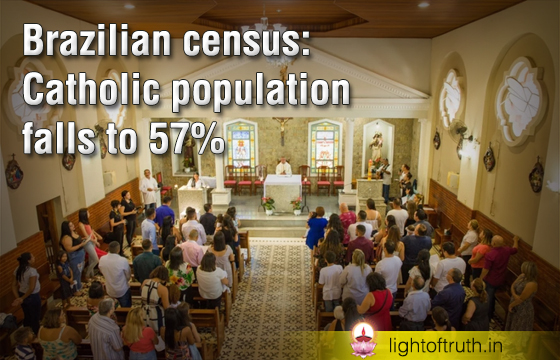
The percentage of Brazilians who identi-fy as Catholic fell to 56.75% in 2022, a reduction of 8.4% compared with 2010, according to data from the 2022 demographic census released by the Brazilian Institute of Geography and Statistics. Despite the reduction, Catholicism remains by far the largest religion in the country, followed by evangelicalism and Brazilians who identify as having no religion, whose percentage has grown by 1.4% since 2010, accounting for 9.28% of the population. Evangelicals posted growth of 5.2% during the period, comprising 26.9% of the country’s population of just over 203 million people.
The trend of increasing numbers of people without a religious affiliation was discussed by the bishops during a January meeting in Rio de Janeiro. The archbishop of Porto Alegre and president of the National Conference of Bishops of Brazil, Cardinal Jaime Spengler, referred to this population as “dechurched.” Spengler said “there is an urgent need to invest in initiation into Christian life and the valorization of small communities of faith so that Catholicism can grow in Brazil.” Other religions account for 4.01% of the population. Spiritists represent 1.84%, while followers of Umbanda and Candomblé account for 1.05%.

From a Railway Platform to the Altar: Abandoned Child Becomes a Priest
Twenty-eight years ago, a frightened five-year-old boy was found alone at Shoranur railway station. He had no memory of his parents or a family to