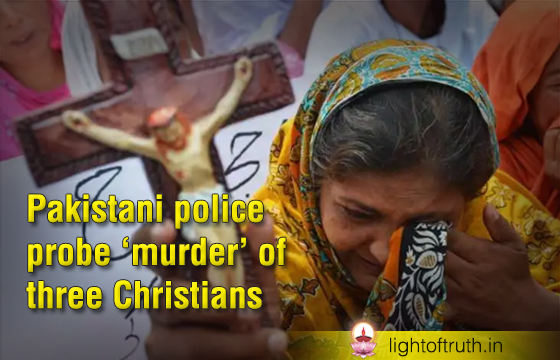
Pakistani police probe ‘murder’ of three Christians

Police in Pakistan’s national capital, Islamabad, have launched an investigation after finding the bodies of three people — a Christian man, his teenage son, and daughter — inside their locked home under mysterious circumstances. The bodies of 42-year-old Akram Paul, his 18-year-old son Shabbir, and 15-year-old daughter Neha were discovered on Sept. 10 inside their residence in Rimsha Colony, according to police inspector Muhammad Aslam of the city’s Sabzi Mandi Police Station. “We are examining all possibilities, including murder and accidental death. No detail is being overlooked,” the officer told UCA News. Police found the bodies after neighbours alerted them, he said.

Quoting police sources, Pakistan daily The Nation reported that the victims had been deceased for approximately two weeks. Their hands were tied, and there were multiple wounds on their bodies. The victims were possibly assaulted with sharp weapons. The door of their house was locked from the outside, and Akram’s motorbike, which was parked outside, was stolen, the news report said.

Pastor Samuel Masih, who leads Paul’s New Life Church in the area, told UCA News that Paul converted to Christianity from Islam “many years ago.” He had been “an active member of the church since his conversion.” Paul reportedly became a Christian but married a Muslim woman after his first wife died. The two children were from his previous marriage.

Pastor Masih and other Christians in the Rimsha Colony, an enclave of some 1,000 Christian families, suspect the murder was a targeted attack motivated by religious hatred. “This is not an ordinary crime. Our brothers and sisters in Christ are living under constant threats. We demand protection and justice,” Masih said. Paul’s Christian neighbour, speaking on condition of anonymity, remarked, “Our children are afraid to leave their homes. The community feels vulnerable and unsafe.” Pastor Masih said the murder of Paul’s family “is a tragedy for the entire Christian community in Islamabad. We demand swift action and protection for our people.”
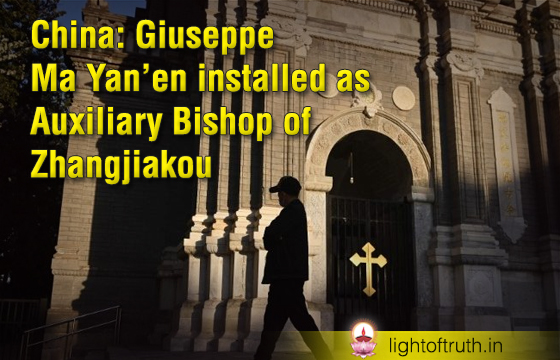
China: Giuseppe Ma Yan’en installed as Auxiliary Bishop of Zhangjiakou

The structure of the new Diocese of Zhangjiakou, established by Pope Leo XIV on July 8 by merging the territories of the Dioceses of Xiwanzi and Xuanhua, is taking further shape. On September 12, the Holy See Press Office reported that, “within the framework of dialogue concerning the application of the Provisional Agreement between the Holy See and the People’s Republic of China,” the “civil recognition and assumption of office” of Giuseppe Ma Yan’en as Auxiliary Bishop of Zhangjiakou took place.

The 65-year-old prelate, already Bishop of Xiwanzi and now assisting Bishop Joseph Wang Zhengu, consecrated as the first Bishop of Zhangjiakou, was born in 1960 in Baoding. He was ordained a priest in 1985 for the Apostolic Prefecture of Yixian, where he served as Vicar General. He received episcopal ordination in January 2010 and in 2013 became Bishop of Xiwanzi, a circumscription of which he took canonical possession on March 28 of that year.

“It is received with satisfaction,” said Matteo Bruni, Director of the Holy See Press Office, “that today, on the occasion of the assumption of office as Auxiliary Bishop of Zhangjiakou by Joseph Ma Yan’en, his episcopal ministry has also been recognised within the framework of civil law.” At the same time, the statement added, “the episcopal dignity of Monsignor Augustine Cui Tai, Bishop Emeritus of Xuanhua, has also been civilly recognised.” “These events, the fruit of dialogue between the Holy See and the Chinese authorities,” Bruni concluded, “represent a significant step in the journey of communion of the new Diocese.”

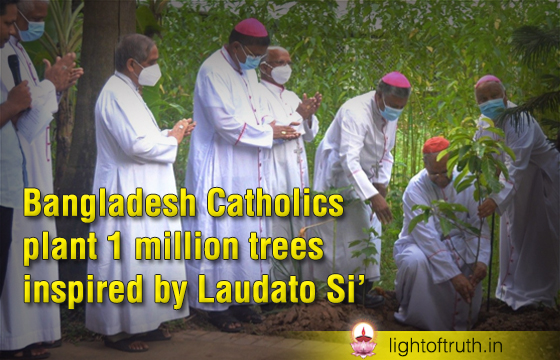
Bangladesh Catholics plant 1 million trees inspired by Laudato Si’

In Bangladesh, the call for “care for nature” in Pope Francis’s encyclical Laudato Si’ has resonated deeply across religious lines. Christians, Protestants, and non-Christians alike have embraced its message, sparking environmental action in a country increasingly vulnerable to climate change. Bangladesh, a coastal South Asian nation, faces frequent natural disasters — floods, cyclones, river erosion, and landslides — that claim lives and displace communities. Ranked as the ninth highest disaster-risk country globally, it sees hundreds of villagers migrating to cities each year due to river erosion and climate-induced hardship.

In response, the Catholic Bishops’ Conference of Bangladesh (CBCB) launched an ambitious initiative to plant one million trees nationwide. The program began on August 14, 2020, during the COVID-19 pandemic, with all bishops present at the CBCB Centre in Dhaka.

“Planting trees remains one of the most powerful actions we can take to combat climate change, which is why our bishops prioritize it,” Father Tushar James Gomes, assistant secretary general of the Catholic Bishops’ Conference of Bangladesh, told Catholic News Agency. “Laudato Si’ has significantly raised awareness about the importance of caring for our environment,” he added. “People now understand that protecting nature is not optional — it’s essential.”

Tushar emphasized that the Church is moving beyond tree planting. “We are working to declare parishes and organizations as ‘green and clean.’ Many church-run organizations are phasing out plastic bottles and single-use items. Though not yet 100% successful, the effort continues.” The Episcopal Commission for Justice and Peace has played a leading role in translating, promoting, and publishing Laudato Si’ in Bengali. Holy Cross Father Liton H. Gomes, secretary of the commission, told Catholic News Agency that public awareness about environmental care has grown significantly.

Interfaith workshops continue to strengthen the movement. On June 27-28, 2025, a training on life and nature protection was held at the CBCB Center in Dhaka, attended by 90 participants, including Catholics and Protestants, organized by the Episcopal Commission for Justice and Peace and World Vision Bangladesh. From tree planting to interfaith dialogue, Bangladesh’s Christian community is living out the spirit of Laudato Si’, proving that care for creation transcends religious boundaries — making it a shared human responsibility.

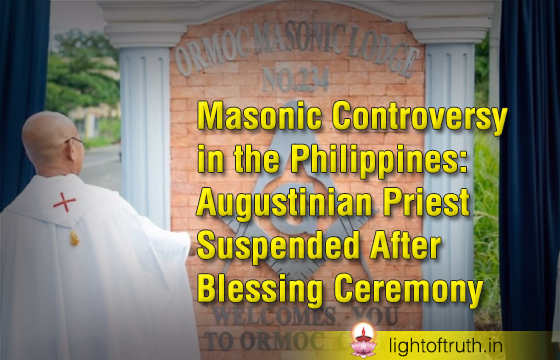
Masonic Controversy in the Philippines: Augustinian Priest Suspended After Blessing Ceremony

The delicate relationship between Catholicism and Freemasonry resurfaced in the Philippines this month when a local priest was suspended after blessing a Masonic marker in a public ceremony. The incident, captured in photographs and quickly circulated on social media, has ignited debate over ecclesial discipline, doctrinal clarity, and the lived realities of Catholic life in a country where Freemasonry has a visible social presence. On September 1, the Discalced Augustinians (OAD) announced the temporary suspension of Father Libby Daños, a priest serving in Ormoc City in Leyte province. The measure followed viral images showing Daños blessing a stone marker inscribed with Masonic symbols — a gesture that, according to Church authorities, contradicts Catholic teaching.

Father Luigi Kerschbamer, provincial prior of the OAD, said the priest had not fully realized the implications of the event but nevertheless acknowledged that the action caused scandal among the faithful. In a formal statement, Kerschbamer emphasized that Daños expressed “deep regret” and is cooperating with a canonical investigation. While the case is under review, Daños is barred from exercising public ministry. “The incident illustrates the need for vigilance,” Kerschbamer wrote, adding that the order is strengthening formation programs for its members to ensure they can discern situations that may compromise the Church’s witness. The suspension comes at a time when the Vatican has repeatedly clarified its stance on the incompatibility between Catholic faith and Masonic affiliation. In November 2023, the Dicastery for the Doctrine of the Faith reiterated that Freemasonry, particularly in the Philippines, is not limited to formal lodge members but includes a wide circle of sympathizers who consider their involvement compatible with Catholic identity. The statement firmly rejected that view, warning Catholics against participation in Masonic activities.

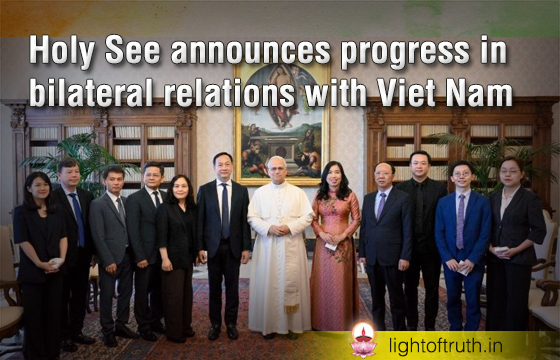
Holy See announces progress in bilateral relations with Viet Nam

The XII meeting of the Viet Nam – Holy See Joint Working Group took place in Vatican City on 12 September 2025. The Meeting was co-chaired by H.E. Madam Le Thi Thu Hang, Deputy Minister of Foreign Affairs, Head of the Vietnamese delegation, and Monsignor Mirosław Wachowski, Under-Secretary for Relations with States, Head of the Holy See delegation.

The two sides held an extensive exchange of views on the Viet Nam – Holy See relations and the current situation of the Catholic Church in Viet Nam. Both sides acknowledged the positive contributions of the Church to the overall development of Viet Nam, in the spirit of living out the Gospel in the world by being good Catholics and good citizens.

Both sides expressed satisfaction with the progress in their bilateral relations since the XI Meeting of the Viet Nam – Holy See Joint Working Group, which took place in Ha Noi in May 2024, including through regular engagement and consultations, exchanges of delegations at various levels, especially at the high level, as well as the activities of the Resident Papal Representative in Ha Noi, H.E. Archbishop Marek Zalewski.

The two sides underlined the importance of further promoting their bilateral relations through high-level exchanges, and agreed to continue holding regular Meetings of the Joint Working Group.

The Meeting took place in an atmosphere of friendship, trust and mutual respect. On the occasion of the visit to the Vatican, the Vietnamese delegation was received by His Holiness Pope Leo XIV, and paid courtesy calls to the Secretary of State, Cardinal Pietro Parolin, and to the Secretary for Relations with States and International Organizations, Archbishop Paul Gallagher.