

Pakistan’s top court has dis-missed a plea by a Christian group seeking an increase in the seats reserved for religious minorities in the national and provincial assemblies.
A two-judge bench of the Supreme Court on Feb. 7 rejected the petition on the grounds that the constitutional amendment was required to increase minority representation. The highest court in the country said it cannot issue directions to the parliament on the issue.
“The court was not authorized to issue an order to the parliament to amend the constitution. How could the court decide for enhancing the minorities’ seats in the parliament,” Justice Ijazul Ahsan observed. The petition brought by the Pakistan Interfaith League (PIL) was earlier rejected by Lahore High Court.
Christian human rights activists had long been demanding an increase in seats for religious minorities from 10 to 14 in the 342-seat national assembly. The national parliament currently has four Christian and six Hindu members.
Currently, religious minorities can contest only 33 reserved seats in the provincial assemblies and four seats in the Senate.
Minority voters account for 3.63 million or 3.5% of the 118 million voters in Pakistan, according to official records.
Daily Archives: February 15, 2022
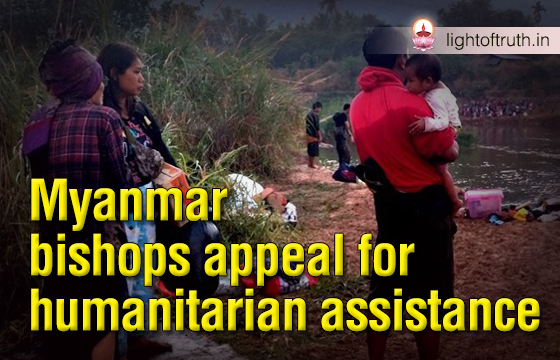
Myanmar bishops appeal for humanitarian assistance
The Catholic Bishops’ Conference of Myanmar has issued a statement last week calling for humanitarian assistance to thou-sands of people who have been displaced by the ongoing conflict in the country.
In a letter of appeal released on Jan. 14, the Church leaders called on “all concerned” to facilitate “humanitarian access to suffering and internally displaced people.” “Human dignity and the right to life can never be compromised,” the Church leaders said in the letter following their general assembly in Yangon last week.
The bishops also called for “respect for life, respect for the sanctity of sanctuary in places of worship, hospitals, and schools.”
The letter also expressed their appreciation to priests, nuns, and catechists who continue to take care of the people “in their flight from dangers of life.”
The bishops called on all Church workers, especially priests, religious men and women, and catechists, to continue the “mission of love and sacrifice for the people irrespective of the faith, race, and place.”
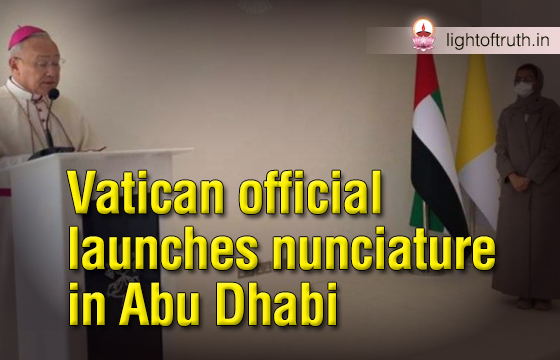
Vatican official launches nunciature in Abu Dhabi
The opening of a new apostolic nunciature in the United Arab Emirates is a testament to fraternity and goodwill between Muslims and Christians, said Archbishop Edgar Peña Parra.
Speaking at the inaugural ceremony in Abu Dhabi Feb. 4, Archbishop Peña, the substitute secretary for general affairs in the Vatican Secretariat of State, said the new nunciature is also “a further sign of the Holy Father’s solicitude and concern for all the people in this land.”
“May this new embassy of the Holy See serve as a place of encounter and dialogue for our bilateral cooperation for many years to come,” the Archbishop said.
Among those present at the inauguration were Sheikh Mohammed bin Zayed Al Nahyan, the crown prince and minister of foreign affairs and international cooperation; Bishop Paul Hinder, apostolic vicar for Southern Arabia; and Msgr. Yoannis Gaid, member of the Higher Committee of Human Fraternity.
The Holy See and the United Arab Emirates established diplomatic relations in 2007, but the nuncio resided in Kuwait. Currently the nunciature is headed by Slovenian Msgr. Kryspin Dubiel, who serves as chargé d’affaires.
The opening of the nunciature coincided with the third anniversary of the day that Pope Francis and Sheikh Ahmad el-Tayeb, grand imam of al-Azhar in Egypt, signed a document on promoting dialogue and “human fraternity” during the Pope’s 2019 apostolic visit to the United Arab Emirates.
The document, Archbishop Peña said, showed that unity between Muslims and Christians is possible through the “shared belief in God the creator of all things” from which “stems the call for believers to live in fraternity with all people regardless of race, religion or creed and to safeguard creation, our common home.”
“Contrary to any distortion or manipulation of religion, the response to this call can be nothing other than choosing the path of dialogue, which leads to better mutual understanding and cooperation,” he said.