Hong Kong cancels church gatherings, Ash Wednesday liturgy

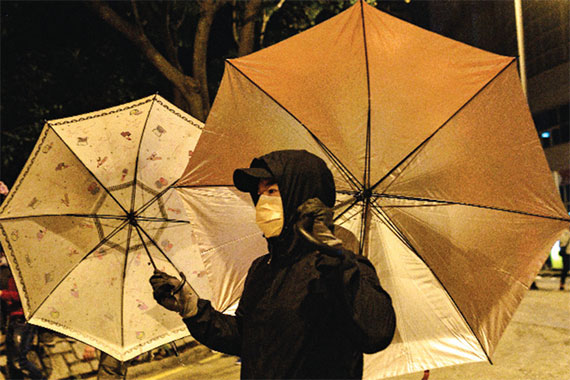
The threat of spreading the corona virus has forced Catholic officials in Hong Kong to suspend all church programs for the next two weeks and cancel the Ash Wednesday liturgy that marks the beginning of the Lent season.

Cardinal John Tong, the apostolic administrator of Hong Kong, said the “disappointing” decision had been taken “because the next two weeks will be a crucial time to suppress the epidemic.”

The diocese has decided to suspend all public Masses on Sundays and weekdays from Feb. 15-28 and to cancel the liturgy of Ash Wednesday, Cardinal Tong said in a Feb. 13 pastoral letter.

Ash Wednesday, which marks seven weeks of fast, abstentions and prayer leading to the Easter feast of Christ’s resurrection, this year falls on Feb. 26.

Hong Kong’s 500,000 Catholics will miss the liturgy in which ash will be smeared on foreheads, reminding humans that they will turn into dust when they die. It calls for repentance and prayers.

The move comes amid global fears that the epidemic, now called COVID-19, has worsened in the last few days in China against the expectations of experts.

The epidemic, first reported in Wuhan city of Hubei province, has spread across the world and claimed 1,369 lives, with more than 60,000 confirmed cases as of Feb. 13, mostly in China.

Hong Kong, which has open borders with China, has reported 50 confirmed cases and one death. Hundreds are now under self-isolation or observation.

“Some church members may be disappointed” with the diocesan move, the cardinal’s message said. But “this is not an easy decision,” he said.

“At this difficult time,” Catholics must “deepen our trust in God and implement our Christian love for our neighbors and all people,” the message said.

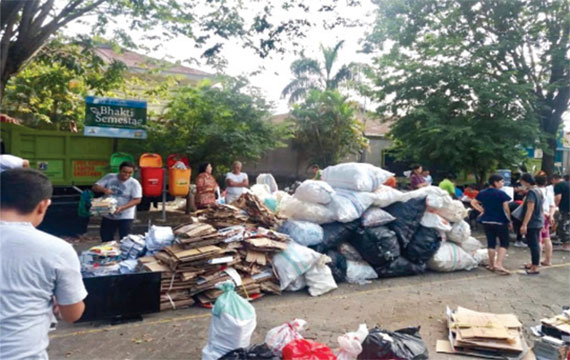
Indonesian Catholics not letting garbage go to waste

Since Jakarta Archdiocese introduced an anti-plastic waste campaign back in 2006, many parishes and individuals have taken it seriously. The campaign to “collect waste, and make it a blessing” has inspired many Catholics, including Lucia Mona Hartari Windoe from the Holy Family Parish in Rawamangun, East Jakarta.

In February 2016, Mona launched a waste management program called the Bhakti Semesta Waste Bank in her parish, just as the country marked its 10th National Waste Care Day.

Through the initiative, she encouraged Catholics in her parish to collect their plastic waste, instead of throwing it away and creating an environmental problem.

She said a waste bank is not a place where people dump their garbage, but rather an initiative to help parishioners who have waste at their homes but do not know what to do with it.

The goal is to raise people’s awareness to care for the environment, and at the same time make a profit out of waste, she said.

In doing so, with the support of her parish priest, she cooperated with the East Jakarta Environment Agency who provided trucks to pick the waste up.

Catholics told not to touch Cross on Good Friday

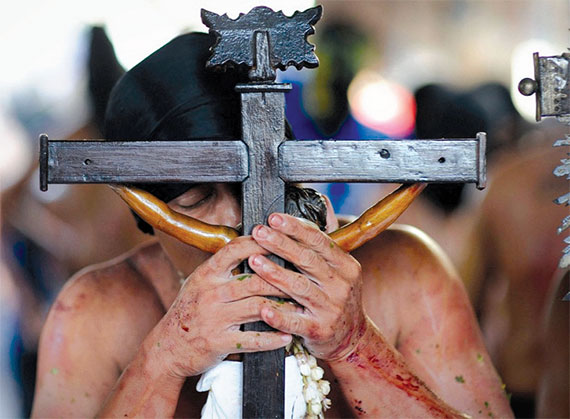
Catholics in the Philippines have been asked not to kiss or touch the cross when they venerate it on Good Friday because of concerns about the corona-virus.

Instead, they should “genuflect or make a profound bow” before the cross during the veneration of the cross, according to updated liturgical guidelines issued on Feb. 20 by the Catholic Bishops’ Conference of the Philippines and posted on Twitter.

Already in January, the bishops’ conference advised priests to distribute the Eucharist in communicants’ hands rather than their mouths, to place protective cloths over the screens of confessionals and to change the holy water in church fonts regularly. The conference also asked the faithful not to hold hands during the “Our Father” and not to shake hands during the sign of peace.

In the new guidelines, which the bishops’ conference said it “strongly recommends” following, priests were asked to distribute ashes on Ash Wednesday, Feb. 26, by “dropping or sprinkling a small portion of blessed ash on the crown of the head of the faithful,” rather than rubbing them on the person’s forehead.

Shot for trying to build a church

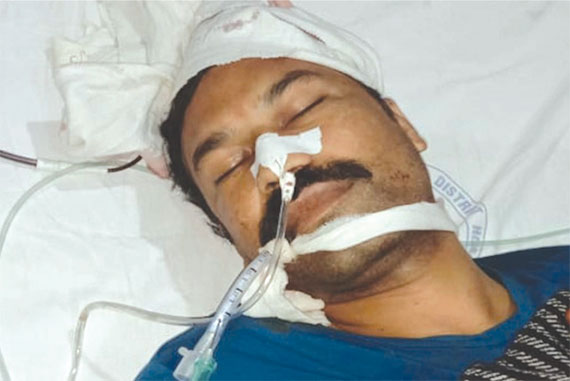
Azeem Gulzar has been left half-paralyzed after being shot in the head in a mob attack on a church under construction in Pakistan. Gulzar, 25, was released from the Civil Hospital Sahiwal on Feb. 24, three weeks after his family tried to resist 15 armed men from pulling down the wall of the church. The Christian tailor had donated his 51-square-meter plot in a village in Punjab’s Sahiwal district for a community church. The Muslim-majority village is home to about 150 Christians.

“He is unable to communicate and is paralyzed from the right shoulder down. One of my cousins is recovering from the wound of a bullet that slightly hit his skull. My uncle was also injured with an axe. We are not rich enough to pursue lengthy court cases. Our property is the only hope we had,” Waseem, his younger brother, told UCA News on Feb. 25.

“There is no church in our village. We gather in the house of a local pastor for weekly prayers. We wanted to facilitate the women and elderly who couldn’t travel each Sunday to the nearby city.”

The attack followed months of heated arguments between Gulzar’s family and Muhammad Liaqat, a Muslim schoolteacher who opposed construction of the church on the empty plot that shares a wall with Liaqat’s house. The District Coordinator Officer had set community consent as a major prerequisite for the registration and issuance of a no-objection certificate (NOC) for the church’s construction. Amid the negotiations, Gulzar’s family erected a front wall and a door at the site on Feb. 2. They were attacked the same night.

“It was Sunday. We spent the whole day building the wall and finished at 7pm. We only wanted to secure our property against any forceful occupation. Three hours later, we heard a crowd chanting on our doorstep. As we tried to explain our stance, someone resorted to aerial firing. My brothers were the next targets,” said Waseem.

Pakistan’s Asia Bibi Asks France For Political Asylum

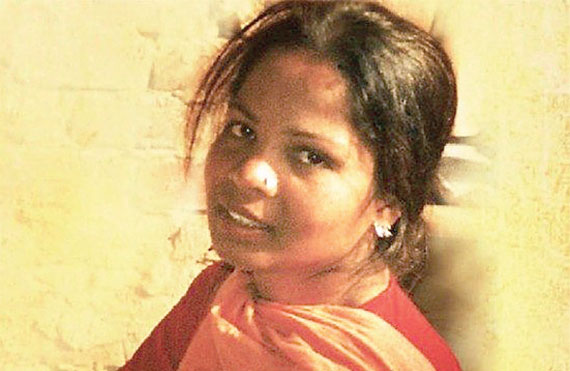
Asia Bibi, the Pakistani Christian woman who spent years on death row after a 2010 conviction of blasphemy, said on February 24 that she was seeking political asylum from the French government.

“My great desire is to live in France,” Bibi said in an interview with RTL radio, her first trip to France since fleeing with her family to Canada in 2018.

Her visit comes a few weeks after the publication of her book “Enfin Libre!” (Finally Free) in French last month, with an English version due in September.

“France is the country from where I received my new life… Anne-Isabelle is an angel for me,” she said, referring to the French journalist Anne-Isabelle Tollet, who waged a long campaign for her release and later co-wrote Bibi’s book.

Paris Mayor Anne Hidalgo is to bestow an honorary citizen-ship certificate granted to Bibi by the city in 2014, when she was still behind bars.