Chinese officials demolish yet another church: in Shanxi

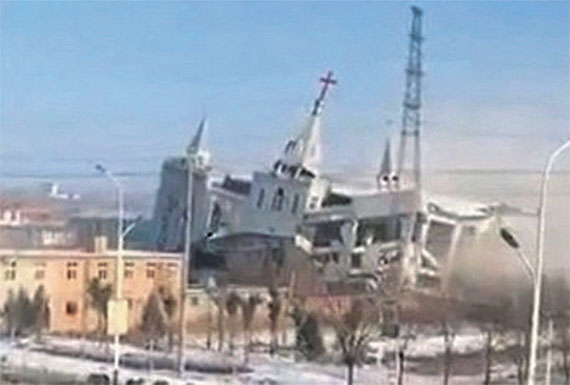
Authorities in China demolished a large church in the city of Linfen, Shanxi province on Jan. 9, despite efforts by worshippers to halt the demolition and who were then pressured to remain silent, according to witnesses. It was the third Christian church demolition or closure in China in just over two weeks and comes amid a broader crackdown on “Western” religions by the government of authoritarian leader Xi Jinping. Muslims groups, especially in the far flung province of Xinjiang have also been targeted.

Officials surrounded the Golden Lampstand Church, while bulldozers reduced the large building to rubble, a witness told Radio Free Asia “It has now been demolished,” a church member said.

The church member, speaking on condition of anonymity, said a large anti-riot team carried out the demolition. ChinaAid, a Texas-based Christian human rights organization, said the Golden Lampstand Church had been subject to government pressure since it was built in 2009.

“China repeatedly cracks down on house churches, which are churches that refuse to register, often to opt out of government monitoring. Officials often prosecute such choices, however, and some of Golden Lampstand Church’s leaders have been imprisoned for one to seven years, simply for serving at their church,” ChinaAid said in a statement on Jan.9.

In Zhejiang province more than 1,500 churches, both Catholic and Protestant, have been targeted for demolition or cross removals in recent years, sources have said in a campaign against churches not coming under state control. Chinese authorities are increasingly using property regulations to remove crosses and demolish churches.

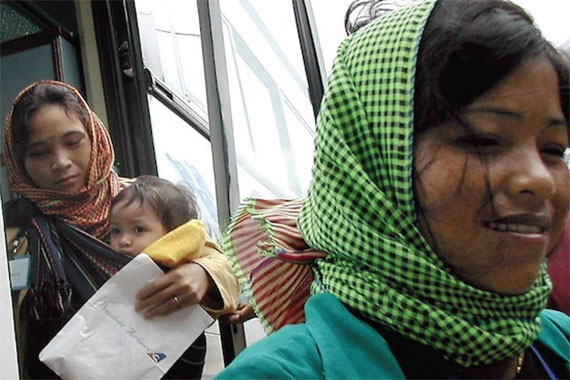
The betrayal of Vietnam’s forgotten Christians

Exasperated after violent interrogations and round-the-clock intimidation at the hands of the Vietnamese government, Christian Montagnard Y-Man Eban escaped into the forests of eastern Cambodia on July 7, 2015.

“The reason I ran away from my country was because the Vietnamese police interrogated me four or five times and put me in jail for a week. They beat me a lot,” Eban, 30, said from Dak Lak province.

When asked why he was arrested, Eban said it was because he sought “the freedom and independence for Dega people.”

Eban was one of more than 300 Montagnard Christians, the indigenous peoples of the Vietnamese Central Highlands, also known as Dega, who three years ago started fleeing into Cambodia with tales of oppression at the hands of the Hanoi government. It was the first exodus in around a decade, when thousands fled amid crackdowns on protests in 2001 and 2004.

Persecuted for decades due to reasons including their support for America in the Vietnam War and their faith, there have been widespread accusations of human rights abuses and land grabs in the rolling hills of the Montagnards’ homeland.

Virtually all have since been returned by the Cambodian authorities and just 20 have been granted refugee status. Eban said the persecution and surveillance back in the Central Highlands had continued unabated since he was sent back in October 2015 after being denied asylum.

“Since I came back to Vietnam, the authorities have viewed me as a criminal,” Eban said. “l regularly read the Bible and pray to God to bless us,” he said. Back in the Central Highlands, Eban had little doubt as to why the Cambodian government appeared so eager to prevent his people finding a safe haven from the wrath of Vietnamese authorities.

US lists Pakistan for ‘violations of religious freedom’

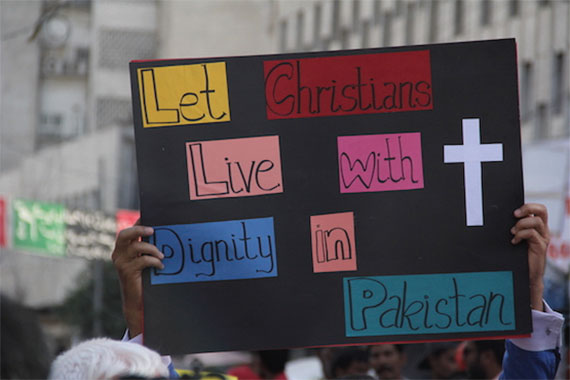
Days after US President Donald Trump threatened to cut American aid to Pakistan, the State Department placed the South Asian Islamic country on a Special Watch List for “severe violations of religious freedom” under the International Religious Freedom Act of 1998.

The move came three days after Trump, in his first tweet of the new year, accused Pakistan of providing a safe haven to terrorists despite receiving billions of dollars in aid over the years.

“The United States has foolishly given Pakistan more than 33 billion dollars in aid over the last 15 years, and they have given us nothing but lies & deceit, thinking of our leaders as fools. They give safe haven to the terrorists we hunt in Afghanistan, with little help. No more!” Trump wrote.

Rejecting Trump’s accusa-tions, Pakistan said its counter-terrorism campaign had served as a bulwark against the expa-nsion of scores of terrorist orga-nizations in Afghanistan — a fact acknowledged by US authorities at the highest level.

Pakistan’s successful counter-terrorism cooperation against Al-Qaeda had led to Pakistan suffe-ring a brutal backlash, including the killing of hundreds of its schoolchildren by terrorists based in Afghanistan, a statement by Pakistan’s powerful National Security Committee said on January 2.

Apart from Pakistan, the US Secretary of State also re-designated Myanmar, China, Eritrea, Iran, North Korea, Sudan, Saudi Arabia, Tajikistan, Turkmenistan and Uzbekistan as “countries of particular concern” on Dec. 22.

On Jan. 4, the Trump admi-nistration announced it had sus-pended all security assistance to Pakistan until it proves its commitment to fight all terrorist groups operating in the region.

Voice from Singapore: ‘Demographic winter’ isn’t just Europe

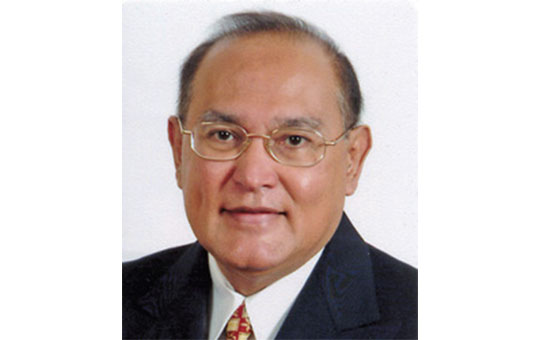
On January 8 Pope Francis delivered his annual address to the diplomatic corps accredited to the Vatican, in what’s generally considered his most important foreign policy speech of the year. It was a typically wide-ranging overview of the global scene, from nuclear disarmament and the dangers of anti-immigrant rhetoric to the pro-life cause and “ideolo-gical colonization.” Crux spoke with Ambassador Barry Desker of Singapore, who was part of the first generation of diplomats from his country after it gained independence from Malaysia in 1965, and who today serves as one of the “non-residential” ambassadors to the Vatican, meaning he does not live full-time in Rome. He said: “The second factor which will have drawn attention is the reference to a “demographic winter,” meaning the decline in birthrates. In Asia, this is something that’s of concern to countries around the region, including Singapore. For example, many have said that China is likely to grow old before it grows rich because of the one-child policy.”

After 50 years, the first public Christmas Festival in Yangon

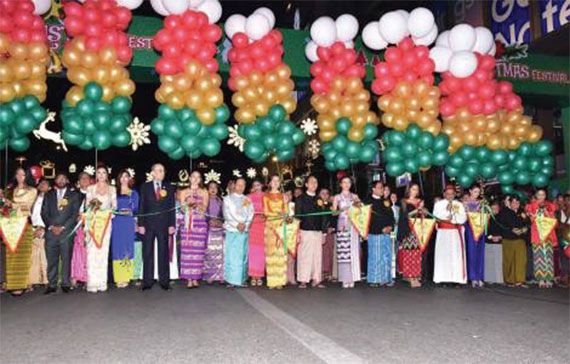
The Christian communities in Myanmar, Catholic and Protest-ant, have publicly celebrated Christmas in the streets of Yangon, for the first time in 50 years: as Agenzia Fides learns, in the past Christmas was strictly confined within the walls of churches, several liturgies, feasts, processions, took place in the city, especially from 23 to 25 December, with the specific authorization of the government authorities of the region of Yangon.

The Festival was inaugurated on December 23 in the Methodist Church of the Holy Trinity and ended on December 25 with a solemn liturgy in the Catholic Cathedral of Santa Maria in Yangon, in the presence of Henry Van Thio, vice president of the Republic of Myanmar. Bishop John Saw Yaw Han, Auxiliary of the Archdiocese of Yangon, declared the happiness of the Burmese Christians for this first Festival and encouraged all fellow citizens “to contribute in every possible way to the peace and prosperity of the nation.” The special Christmas Festival was initiated with the consent of Phyo Min Thein, Prime Minister of the Regional Government of Yangon, and Mg Mg Soe, Mayor of Yangon, with the explicit intention of “honoring Pope Francis’ visit to Myanmar held in November 2017 and to show solidarity with Christians in Myanmar and in the world.”